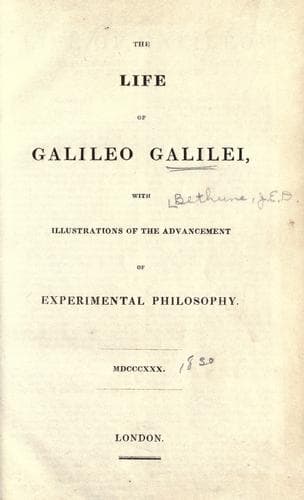
The biography of men who have devoted themselves to philosophical
pursuits seldom affords so various and striking a succession of
incidents as that of a soldier or statesman. The life of a man who is
shut up during the greater part of his time in his study or laboratory
supplies but scanty materials for personal details; and the lapse of
time rapidly removes from us the opportunities of preserving such
peculiarities as might have been worth recording. An account of it will
therefore consist chiefly in a review of his works and opinions, and of
the influence which he and they have exercised over his own and
succeeding ages. Viewed in this light, few lives can be considered more
interesting than that of Galileo; and if we compare the state in which
he found, with that in which he left, the study of nature, we shall feel
how justly an enthusiastic panegyric pronounced upon the age immediately
following him may be transferred to this earlier period. "This is the
age wherein all men's minds are in a kind of fermentation, and the
spirit of wisdom and learning begins to mount and free itself from those
drossie and terrene impediments wherewith it has been so long clogged,
and from the insipid phlegm and _caput mortuum_ of useless notions in
which it hath endured so violent and long a fixation. This is the age
wherein, methinks, philosophy comes in with a spring tide, and the
peripatetics may as well hope to stop the current of the tide, or, with
Xerxes, to fetter the ocean, as hinder the overflowing of free
philosophy. Methinks I see how all the old rubbish must be thrown away,
and the rotten buildings be overthrown and carried away, with so
powerful an inundation. These are the days that must lay a new
foundation of a more magnificent philosophy, never to be overthrown,
that will empirically and sensibly canvass the phenomena of nature,
deducing the causes of things from such originals in nature as we
observe are producible by art, and the infallible demonstration of
mechanics: and certainly this is the way, and no other, to build a true
and permanent philosophy."[3]
FOOTNOTES:
[1] Ménage.
[2] Hume's England, James I.
[3] Power's Experimental Philosophy, 1663.
CHAPTER II.
_Galileo's Birth—Family—Education—Observation of the
Pendulum—Pulsilogies—Hydrostatical Balance—Lecturer at Pisa._
Public-domain text, read in full here on John Shaqi.
Reviews
Reviews
No reviews yet
Be the first to share your thoughts on this work.
Join the Discussion
Join the discussion
Sign in to leave a comment or review.
Sign InorCreate an account