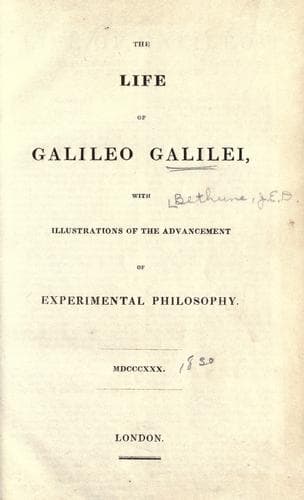
GALILEO GALILEI was born at Pisa, on the 15th day of February, 1564, of
a noble and ancient Florentine family, which, in the middle of the
fourteenth century, adopted this surname instead of Bonajuti, under
which several of their ancestors filled distinguished offices in the
Florentine state. Some misapprehension has occasionally existed, in
consequence of the identity of his proper name with that of his family;
his most correct appellation would perhaps be Galileo de' Galilei, but
the surname usually occurs as we have written it. He is most commonly
spoken of by his Christian name, agreeably to the Italian custom; just
as Sanzio, Buonarotti, Sarpi, Reni, Vecelli, are universally known by
their Christian names of Raphael, Michel Angelo, Fra Paolo, Guido, and
Titian.
Several authors have followed Rossi in styling Galileo illegitimate, but
without having any probable grounds even when they wrote, and the
assertion has since been completely disproved by an inspection of the
registers at Pisa and Florence, in which are preserved the dates of his
birth, and of his mother's marriage, eighteen months previous to it.[4]
His father, Vincenzo Galilei, was a man of considerable talent and
learning, with a competent knowledge of mathematics, and particularly
devoted to the theory and practice of music, on which he published
several esteemed treatises. The only one which it is at present easy to
procure—his Dialogue on ancient and modern music—exhibits proofs, not
only of a thorough acquaintance with his subject, but of a sound and
vigorous understanding applied to other topics incidentally discussed.
There is a passage in the introductory part, which becomes interesting
when considered as affording some traces of the precepts by which
Galileo was in all probability trained to reach his preeminent station
in the intellectual world. "It appears to me," says one of the speakers
in the dialogue, "that they who in proof of any assertion rely simply on
the weight of authority, without adducing any argument in support of it,
act very absurdly: I, on the contrary, wish to be allowed freely to
question and freely to answer you without any sort of adulation, as well
becomes those who are truly in search of truth." Sentiments like these
were of rare occurrence at the close of the sixteenth century, and it is
to be regretted that Vincenzo hardly lived long enough to witness his
idea of a true philosopher splendidly realized in the person of his son.
Vincenzo died at an advanced age, in 1591. His family consisted of three
sons, Galileo, Michel Angelo, and Benedetto, and the same number of
daughters, Giulia, Virginia, and Livia. After Vincenzo's death the chief
support of the family devolved upon Galileo, who seems to have assisted
them to his utmost power. In a letter to his mother, dated 1600,
relative to the intended marriage of his sister Livia with a certain
Pompeo Baldi, he agrees to the match, but recommends its temporary
Public-domain text, read in full here on John Shaqi.
Reviews
Reviews
No reviews yet
Be the first to share your thoughts on this work.
Join the Discussion
Join the discussion
Sign in to leave a comment or review.
Sign InorCreate an account