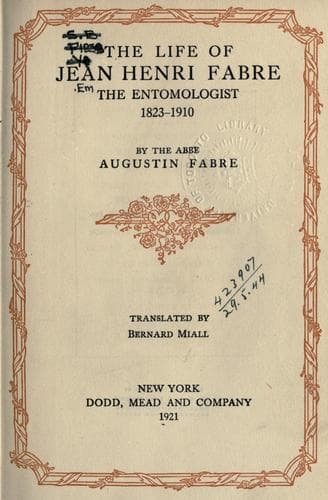
The life of Jean Henri Fabre, the entomologist, 1823-1910Fabre, Augustin
Science
The life of Jean Henri Fabre, the entomologist, 1823-1910
Fabre, Augustin
Entomologists -- France -- Biography; Fabre, Jean-Henri, 1823-1915
But this arrangement and this selection are by no means inspired by the
official classifications. We may attempt, as many eminent naturalists
have done, to class his various monographs in the classic manner. We
shall then say, with M. Perrier, that he is not greatly occupied with
the Lepidoptera, that he studies more particularly the Hymenoptera,
Coleoptera, and Orthoptera, without neglecting the Arachnoids, which
are Arthropods, not insects properly so called. It is a fact that this
singular entomologist prefers the horrible Spiders, to whom all the
good text-books refuse the name of insect, to the most beautiful
Butterflies. It is true that he is especially attracted by the
four-winged flies, the Wasps and wild Bees, the Dung-Beetles and
Necrophori, the Mantes, Grasshoppers, and Scorpions; but this is not
because of any particular affection for this group or on account of
their quality of Hymenoptera, Coleoptera, and Orthoptera; for many of
their congeners are neglected and many insects are selected out of
their order. This is bound to be the case, for the official
classification is conceived on totally different lines to his own,
going by the form of the insect without heeding its actions and its
habits. It is much the same with the official nomenclature.
“If, by chance, an amalgam of Greek or Latin gives a meaning which
alludes to its manner of life, the reality is very often in
disagreement with the name, because the classifier, working over a
necropolis, has outstripped the observer, whose attention is fixed upon
the community of the living.” [169]
So the historian of the insects takes the greatest liberties with
official science and the official language.
A Spider is not an insect, according to the rules of
classification; and as such the Epeira seems out of place here. A
fig for systems! It is immaterial to the student of instinct
whether the animal have eight legs instead of six, or pulmonary
sacs instead of air-tubes. [170]
Above all, Fabre is interested in the study of instinct. It is this
that determines his choice of the species and the data with which he
occupies his leisure and entertains his readers.
Led by this purpose, allured by this vision, he turns by preference to
the most richly-endowed species, disdaining the inept, though they may
be the most beautiful and the most resplendent, like the Butterflies;
and he is often attracted by creatures, great or small, which have
scarcely anything in common with the insects save their habits. Thus
the ferocity of the Spiders will justify their taking rank next to the
Scorpions, the Mantes and the Grasshoppers, the cruelest and most
ancient of terrestrial creatures.
Public-domain text, read in full here on John Shaqi.
Reviews
Reviews
No reviews yet
Be the first to share your thoughts on this work.
Elsewhere in the archive
Join the Discussion
Join the discussion
Sign in to leave a comment or review.
Sign InorCreate an account