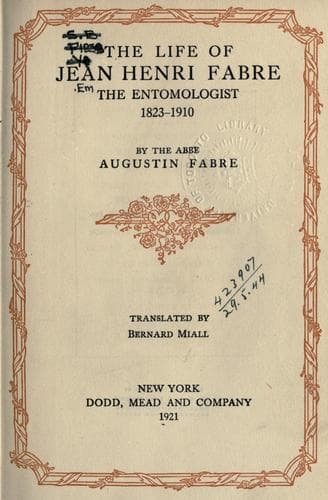
The life of Jean Henri Fabre, the entomologist, 1823-1910Fabre, Augustin
Science
The life of Jean Henri Fabre, the entomologist, 1823-1910
Fabre, Augustin
Entomologists -- France -- Biography; Fabre, Jean-Henri, 1823-1915
His life: it was his study, his museum of natural history, his
laboratory, where, with closed doors, face to face with Nature, he
repeated, in order to perfect them, to consign them to writing, his
open-air researches, his observations of the to-day or yesterday. Now
he no longer sets foot in it, and now one saw—with what respect and
tenderness—only the marks left by his footsteps upon the tiled floor,
as he came and went about the big observation-table, which occupies all
the middle of the room, in pursuit of the solution of the problems
propounded by his insects.
And we have a feeling that we are looking upon, and handling, relics,
when on this table we still see the pocket-lenses, the microscopes and
modest apparatus which has served for his experiments. And we have the
same feeling before the collections in the glass-topped cases of
polished pine which stand against the whitewashed walls, and before the
hundred and twenty volumes of the magnificent herbarium which stand in
a row beneath them, and before the innumerable portfolios of
mycological plates, in which vivid colour is blended so well with
delicacy of drawing, and before the registers and stacks of notes in
fine, clear handwriting, without erasures, which promised a fresh
series of Souvenirs.
Must they be left thus abandoned previous to their being dispersed or
falling into other hands—all these precious fragments of an
incomparable life, and these venerable premises, consecrated by such
rare memories?
The great naturalist’s disciples could not resign themselves to the
thought, and by a touching inspiration of filial piety they have found
the means to secure these treasures, as by a love stronger than death,
against this harrowing dispersal.
To keep the dead in their last dwelling, or attract them thither, the
ancient Egyptians used to place there the image of their earthly
dwelling, offering them at least a reduced facsimile of their life’s
environment, of the objects and premises which had in some sort made
part of their life and their soul.
Fabre’s friends sought to do still better. In order to preserve it in
its integrity, they determined to acquire the Harmas, with its
plantations, its collections, and all its dependencies, and in order to
make their homage as complete as possible they made, with this object,
an appeal for international subscriptions, which were unhappily
interrupted by the war.
“This is the museum which we wish to dedicate to him,” said the chief
promoter of this pious undertaking, [208] “so that in after years, when
the good sage who knew the language of the innumerable little creatures
of the country-side shall rest beneath the cypresses of his harmas, at
the foot of the laurestinus bushes, amidst the thyme and the sage that
the bees will still rifle, all those whom he has taught, all those whom
he has charmed, may feel that something of his soul still wanders in
his garden and animates his house.”
Public-domain text, read in full here on John Shaqi.
Reviews
Reviews
No reviews yet
Be the first to share your thoughts on this work.
Elsewhere in the archive
Join the Discussion
Join the discussion
Sign in to leave a comment or review.
Sign InorCreate an account