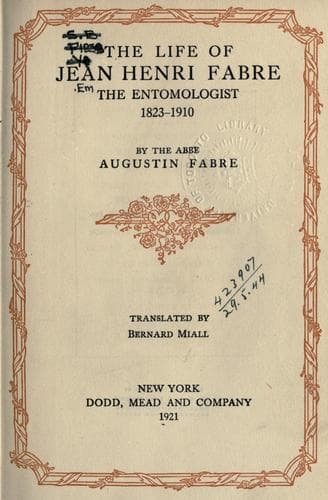
The life of Jean Henri Fabre, the entomologist, 1823-1910Fabre, Augustin
Science
The life of Jean Henri Fabre, the entomologist, 1823-1910
Fabre, Augustin
Entomologists -- France -- Biography; Fabre, Jean-Henri, 1823-1915
But who is the Moussu Fabré thus cherished by the simplest as well as
by the most cultivated minds? He is a sturdy old man of all but ninety
years, who has spent almost the whole of his life in the company of
Wasps, Bees, Gnats, Beetles, Spiders, and Ants, and has described the
doings of these tiny creatures in a most wonderful fashion in ten large
volumes entitled Souvenirs Entomologiques or Etudes sur l’Instinct et
les Mœurs des Insectes. [3]
One might say of this achievement what the author of Lettres Persanes
said of his book: Proles sine matre. It is a child without a mother. It
is, in short, unprecedented. [4] It has not its fellow, either in the
Machal of Solomon, or the apologues of the old fabulists, or the
treatises on natural history written by our modern scientists. The
fabulists look to find man in the animal, which for them is little more
than a pretext for comparisons and moral narratives, and the scientists
commonly confine their curiosity to the dissection of the insect’s
organs, the analysis of its functions, and the classification of
species. We might even say that the insect is the least of their cares,
for, like Solomon, they delight in holding forth upon all the creatures
upon the earth or in the heavens above, and all the plants “from the
cedar tree that is in Lebanon even unto the hyssop that springeth out
of the wall” (1 Kings iv: 32–33).
Fabre, on the contrary, has eyes only for the insect. He observes it by
and for itself, in the most trivial manifestations of its life: the
living, active insect, with its labours and its habits, is the thing
that interests him before all else, guiding his investigation of the
infinite host of these tiny lives, which claim his attention on every
hand; and in this world of insects wealth of artifice and capacities of
the mental order seem to be in an inverse ratio to beauty of form and
brilliance of colour. For this reason Fabre learns to disdain the
magnificent Butterfly, applying himself by preference to the modest
Fly: the two-winged Flies, which are relatives of our common House-fly,
or the four-winged Flies, the numerous and infinitely various cousins
of the Wasps and Bees; the Spiders, ugly indeed, but such skilful
spinners, and even the Dung-beetles and Scarabæidæ of every species,
those wonderful agents of terrestrial purification.
In this singular world, which affords him the society which he prefers,
he has gathered an ample harvest of unexpected facts and highly
perplexing actions on the part of these little so-called inferior
animals. No one has excelled him in detecting their slightest
movements, and in surprising all the secrets of their lives. Darwin
declared, and many others have repeated his words, that Fabre was “an
incomparable observer.” The verdict is all the more significant in that
the French entomologist did not scruple to oppose his observations to
the theories of the famous English naturalist.
Public-domain text, read in full here on John Shaqi.
Reviews
Reviews
No reviews yet
Be the first to share your thoughts on this work.
Join the Discussion
Join the discussion
Sign in to leave a comment or review.
Sign InorCreate an account