The life of Jean Henri Fabre, the entomologist, 1823-1910 — John Shaqi
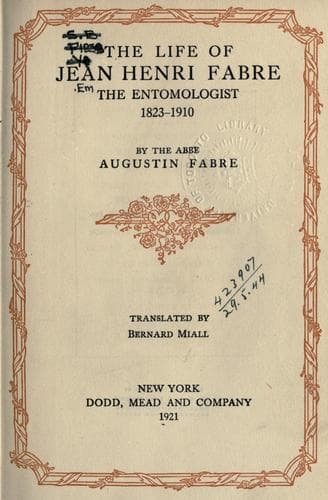
The life of Jean Henri Fabre, the entomologist, 1823-1910Fabre, Augustin
Science
The life of Jean Henri Fabre, the entomologist, 1823-1910
Fabre, Augustin
Entomologists -- France -- Biography; Fabre, Jean-Henri, 1823-1915
Not only in the certainty and the detailed nature of his facts, but
also in the colour and reality of his descriptions is his mastery
revealed. In him the naturalist is reduplicated by a man of letters and
a poet, who “understands how to cast over the naked truth the magic
mantle of his picturesque language,” [5] making each of his humble
protagonists live again before our eyes, each with its characteristic
achievements. So striking is this power of his that Victor Hugo
described him as “the insects’ Homer,” while one of the most
accomplished of our scientists, Mr. Edmond Perrier, Director of the
Museum of Natural History, not content with saluting him as “one of the
princes of natural history,” speaks of his literary work in the
following terms:
The ten volumes of his Souvenirs Entomologiques will remain one of
the most intensely interesting works which have ever been written
concerning the habits of insects, and also one of the most
remarkable records of the psychology of a great observer of the
latter part of the nineteenth century. In them the author depicts
to the life not only the habits and the instincts of the insects;
he gives us a full-length portrait of himself. He makes us share
his busy life, amid the subjects of observation which incessantly
claim his attention. The world of insects hums and buzzes about
him, obsesses him, calling his attention from all directions,
exciting his curiosity; he does not know which way to turn.
Overwhelmed by the innumerable winged army of the drinkers of
nectar who, on the fine summer days, invade his field of
observation, he calls to his aid his whole household: his
daughters, Claire, Aglaé, and Anna, his son Paul, his workmen, and
above all his man-servant Favier, an old countryman who has spent
his life in the barracks of the French colonies, a man of a
thousand expedients, who watches his master with an incredulous yet
admiring eye, listening to him but refusing to be convinced, and
shocking him by the assertion, which nothing will induce him to
retract, that the bat is a rat which has grown wings, the slug an
old snail which has lost its shell, the night-jar a toad with a
passion for milk, which has sprouted feathers the better to suck
the goats’ udders at night, and so forth. The cats and the dog join
the company at times, and one almost regrets that one is not within
reach of the sturdy old man, so that one might respond to his call.
Public-domain text, read in full here on John Shaqi.
Reviews
Reviews
No reviews yet
Be the first to share your thoughts on this work.
Join the Discussion
Join the discussion
Sign in to leave a comment or review.
Sign InorCreate an account