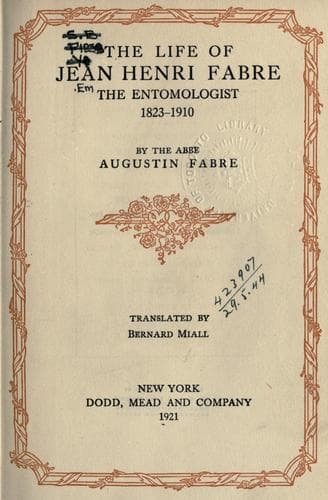
The life of Jean Henri Fabre, the entomologist, 1823-1910Fabre, Augustin
Science
The life of Jean Henri Fabre, the entomologist, 1823-1910
Fabre, Augustin
Entomologists -- France -- Biography; Fabre, Jean-Henri, 1823-1915
See him lying on the sand where everything is grilling in the
burning rays of the sun, watching some wasp that is digging its
burrow, noting its least movement, trying to divine its intentions,
to make it confess the secret of its actions, following the labours
of the innumerable Scarabaei that clean the surface of the soil of
all that might defile it—the droppings of large animals, the
decomposing bodies of small birds, moles, or water-rats; putting
unexpected difficulties in their way, slily giving these tiny
life-companions of his problems of his own devising to solve. [6]
That is well-expressed, and it gives us a fairly correct idea of the
vital and poetic charm of the Souvenirs.
The same writer asks, speaking of the well-defined tasks performed by
all these little creatures beloved of the worthy biologist of Sérignan:
“Who has taught each one its trade, to the exclusion of any other, and
allotted the parts which they fill, as a rule with a completeness
unequalled, save by ‘their absolute unconsciousness of the goal at
which they are aiming?’ This is a very important problem: it is the
problem of the origin of things. Henri Fabre has no desire to grapple
with it. Living in perpetual amazement, amid the miracles revealed by
his genius, he observes, but he does not explain.”
For the moment we can no longer subscribe to the assertions of the
learned Academician, [7] nor to his fashion of writing history, which
is decidedly too free. The truth is that Fabre, who delights in the
pageant of the living world, does not always confine himself to
recording it; he readily passes from the smallest details of
observation to the wide purviews of reason, and he is at times as much
a philosopher as a poet and a naturalist. The truth is that he often
considers the question of the origins of life, and he answers it
unequivocally like the believer that he is. It is enough to cite one
passage among others, a passage which testifies to a brief uplifting of
the heart that presupposes many others: “The eternal question, if one
does not rise above the doctrine of dust to dust: how did the insect
acquire so discerning an art?” And the following lines from the close
of the same chapter: “The pill-maker’s work confronts the reflective
mind with a serious problem. It offers us these alternatives: either we
must grant the flattened cranium of the Dung-beetle the distinguished
honour of having solved for itself the geometrical problem of the
alimentary pill, or we must refer it to a harmony that governs all
things beneath the eye of an Intelligence which, knowing all things,
has provided for all?” [8]
Public-domain text, read in full here on John Shaqi.
Reviews
Reviews
No reviews yet
Be the first to share your thoughts on this work.
Join the Discussion
Join the discussion
Sign in to leave a comment or review.
Sign InorCreate an account