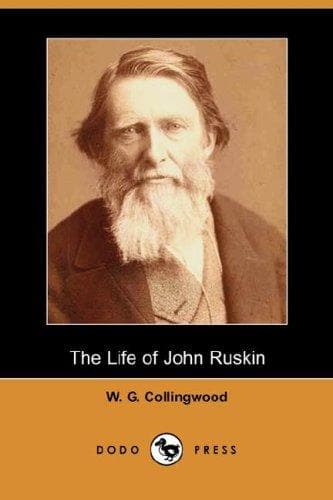
The Life of John RuskinCollingwood, W. G. (William Gershom)
Philosophy
The Life of John Ruskin
Collingwood, W. G. (William Gershom)
Authors, English -- 19th century -- Biography; Ruskin, John, 1819-1900
On January 1st, 1871, was issued a small pamphlet, headed "Fors
Clavigera," in the form of a letter to the working men and labourers of
England, dated from Denmark Hill, and signed "John Ruskin." It was not
published in the usual way, but sold by the author's engraver, Mr.
George Allen, at Heathfield Cottage, Keston, Kent. It was not
advertised; press-copies were sent to the leading papers; and of course
the author's acquaintance knew of its publication. Strangers, who heard
of this curious proceeding, spread the report that in order to get
Ruskin's latest, you had to travel into the country, with your
sevenpence in your hand, and transact your business among Mr. Allen's
beehives. So you had, if you wanted to see what you were buying; for no
arrangements were made for its sale by the booksellers: sevenpence a
copy, carriage paid, no discount, and no abatement on taking a quantity.
By such pilgrimages, but more easily through the post, the new work
filtered out, in monthly instalments, to a limited number of buyers.
After three years the price was raised to tenpence. In 1875 the first
thousands of the earlier numbers were sold: "the public has a very long
nose," Mr. Ruskin once said, "and scents out what it wants, sooner or
later." A second edition was issued, bound up into yearly volumes, of
which eight were ultimately completed. Meanwhile the work went on,
something in the style of the old Addison _Spectator_; each part
containing twenty pages, more or less, by Ruskin, with added
contributions from various correspondents.
The charm of "Fors" is neither in epigram nor in anecdote, but in the
sustained vivacity that runs through the texture of the work; the
reappearance of golden threads of thought, glittering in new figures,
and among new colours; and throughout all the variety of subject a unity
of style unlike the style of his earlier works, where flowery rhetorical
passages are tagged to less interesting chapters, separately studied
sermonettes interposed among the geology, and Johnson, Locke, Hooker,
Carlyle--or whoever happened to be the author he was reading at the
time--frankly imitated. It was always clever, but often artificial; like
the composition of a Renaissance painter who inserts his _bel corpo
ignudo_ to catch the eye. In "Fors," however, the web is of a piece, all
sparkling with the same life; though as it is gradually unwound from the
loom it is hard to judge the design. That can only be done when it is
reviewed as a whole.
At the time, his mingling of jest and earnest was misunderstood even by
friends. The author learnt too painfully the danger of seeming to trifle
with cherished beliefs. He forswore levity, but soon relapsed into the
old style, out of sheer sincerity: for he was too much in earnest not to
be frankly himself in his utterances, without writing up to, or down to,
any other person's standard.
Public-domain text, read in full here on John Shaqi.
Reviews
Reviews
No reviews yet
Be the first to share your thoughts on this work.
Elsewhere in the archive
Join the Discussion
Join the discussion
Sign in to leave a comment or review.
Sign InorCreate an account