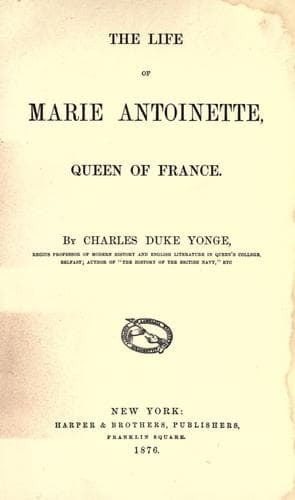
The Life of Marie Antoinette, Queen of France — John Shaqi
The Life of Marie Antoinette, Queen of FranceYonge, Charles Duke
History
The Life of Marie Antoinette, Queen of France
Yonge, Charles Duke
Marie Antoinette, Queen, consort of Louis XVI, King of France, 1755-1793
The superintendence of her vast empire occupied a greater share of Maria
Teresa's attention than the management of her family. But as Marie
Antoinette grew up, the Empress-queen's ambition, ever on the watch to
maintain and augment the prosperity of her country, perceived in her
child's increasing attractions a prospect of cementing more closely an
alliance which she had contracted some years before, and on which she
prided herself the more because it had terminated an enmity of two
centuries and a half. From the day on which Charles V, prevailed over
Francis I. in the competition for the imperial crown, the attitude of the
Emperor of Germany and of the King of France to each other had been one of
mutual hostility, which, with but rare exceptions, had been greatly in
favor of the latter country. The very first years of Maria Teresa's own
reign had been imbittered by the union of France with Prussia in a war
which had deprived her of an extensive province; and she regarded it as
one of the great triumphs of Austrian diplomacy to have subsequently won
over the French ministry to exchange the friendship of Frederick of
Prussia for her own, and to engage as her ally in a war which had for its
object the recovery of the lost Silesia. Silesia was not recovered. But
she still clung to the French alliance as fondly as if the objects which
she had originally hoped to gain by it had been fully accomplished; and,
as the heir to the French monarchy was very nearly of the same age as the
young archduchess, she began to entertain hopes of uniting the two royal
families by a marriage which should render the union between the two
nations indissoluble. She mentioned the project to some of the French
visitors at her court, whom she thought likely to repeat her conversation
on their return to their own country. She took care that reports of her
daughter's beauty should from time to time reach the ears of Louis XV. She
had her picture painted by French artists. She made a proficiency in the
French language the principal object of her education; bringing over some
French actors to Vienna to instruct her in the graces of elocution, and
subsequently establishing as her chief tutor a French ecclesiastic, the
Abbé de Vermond, a man of extensive learning, of excellent judgment, and
of most conscientious integrity. The appointment would have been in every
respect a most fortunate one, had it not been suggested by Loménie de
Brienne, Archbishop of Toulouse, who thus laid the abbé under an
obligation which was requited, to the great injury of France, nearly
twenty years afterward, when M. de Vermond, who still remained about the
person of his royal mistress, had an opportunity of exerting his influence
to make the archbishop prime minister.
Public-domain text, read in full here on John Shaqi.
Reviews
Reviews
No reviews yet
Be the first to share your thoughts on this work.
Join the Discussion
Join the discussion
Sign in to leave a comment or review.
Sign InorCreate an account