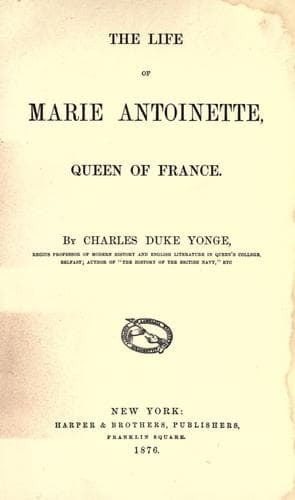
The Life of Marie Antoinette, Queen of FranceYonge, Charles Duke
History
The Life of Marie Antoinette, Queen of France
Yonge, Charles Duke
Marie Antoinette, Queen, consort of Louis XVI, King of France, 1755-1793
Not that her studies were confined to French. Metastasio taught her
Italian; Gluck, whose recently published opera of "Orfeo" had, established
for him a reputation as one of the greatest musicians of the age, gave her
lessons on the harpsichord. But we fear it can not be said that she
obtained any high degree of excellence in these or in any other
accomplishments. She was not inclined to study; and, with the exception of
the abbé, her masters and mistresses were too courtly to be peremptory
with an archduchess. Their favorable reports to the Empress-queen were
indeed neutralized by the frankness with which their pupil herself
confessed her idleness and failure to improve. But Maria Teresa was too
much absorbed in politics to give much heed to the confession, or to
insist on greater diligence; though at a later day Marie Antoinette
herself repented of her neglect, and did her best to repair it, taking
lessons in more than one accomplishment with great perseverance during the
first years of her residence at Versailles, because, as she expressed
herself, the dauphiness was bound to take care of the character of the
archduchess.
There are, however, lessons of greater importance to a child than any
which are given by even the most accomplished masters--those which flow
from the example of a virtuous and sensible mother; and those the young
archduchess showed a greater aptitude for learning. Maria Teresa had set
an example not only to her own family, but to all sovereigns, among whom
principles and practices such as hers had hitherto been little recognized,
of regarding an attention to the personal welfare of all her subjects,
even of those of the lowest class, as among the most imperative of her
duties. She had been accessible to all. She had accustomed the peasantry
to accost her in her walks; she had visited their cottages to inquire into
and relieve their wants. And the little Antoinette, who, more than any
other of her children, seems to have taken her for an especial model, had
thus, from her very earliest childhood, learned to feel a friendly
interest in the well-doing of the people in general; to think no one too
lowly for her notice, to sympathize with sorrow, to be indignant at
injustice and ingratitude, to succor misfortune and distress. And these
were habits which, as being implanted in her heart, she was not likely to
forget; but which might be expected rather to gain strength by indulgence,
and to make her both welcome and useful to any people among whom her lot
might be cast.
CHAPTER II.
Proposal for the Marriage of Marie Antoinette to the Dauphin.--Early
Education of the Dauphin.--The Archduchess leaves Vienna in April, 1770.--
Her Reception at Strasburg.--She meets the King at Compiègne.--The
Marriage takes place May 16th, 1770.
Public-domain text, read in full here on John Shaqi.
Reviews
Reviews
No reviews yet
Be the first to share your thoughts on this work.
Join the Discussion
Join the discussion
Sign in to leave a comment or review.
Sign InorCreate an account