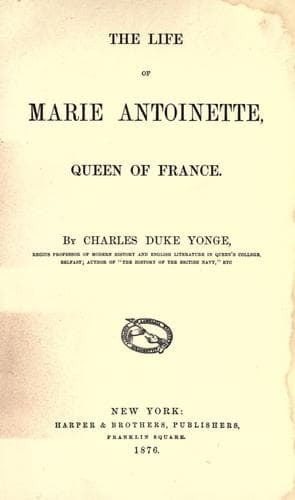
The Life of Marie Antoinette, Queen of FranceYonge, Charles Duke
History
The Life of Marie Antoinette, Queen of France
Yonge, Charles Duke
Marie Antoinette, Queen, consort of Louis XVI, King of France, 1755-1793
"I have inspired her with an eager desire to do her duty to you, with a
tender attachment to your person, with a resolution to be attentive to
think and do every thing which may please you. I have also been most
careful to enjoin her a tender devotion toward the Master of all
Sovereigns, being thoroughly persuaded that we are but badly providing for
the welfare of the nations which are intrusted to us when we fail in our
duty to Him who breaks sceptres and overthrows thrones according to his
pleasure.
"I say, then, to you, my dear dauphin, as I say to my daughter: 'Cultivate
your duties toward God. Seek to cause the happiness of the people over
whom you will reign (it will be too soon, come when it may). Love the
king, your grandfather; be humane like him; be always accessible to the
unfortunate. If you behave in this manner, it is impossible that happiness
can fail to be your lot.' My daughter will love you, I am certain, because
I know her. But the more that I answer to you for her affection, and for
her anxiety to please you, the more earnestly do I entreat you to vow to
her the most sincere attachment.
"Farewell, my dear dauphin. May you be happy. I am bathed in tears.[2]"
The dauphin did not falsify the hopes thus expressed by the Empress-queen.
But his was not the character to afford his wife either the advice or
support which she needed, while, strange to say, he was the only member of
the royal family to whom she could look for either. The king was not only
utterly worthless and shameless, but weak and irresolute in the most
ordinary matters. Even when in the flower and vigor of his age, he had
never been able to summon courage to give verbal orders or reproofs to his
own children,[3] but had intimated his pleasure or displeasure by letters.
He had been gradually falling lower and lower, both in his own vices and
in the estimation of the world; and was now, still more than when Lord
Chesterfield first drew his picture,[4] both hated and despised. The
dauphin's brothers, for such mere boys, were singularly selfish and
unamiable; and the only female relations of her husband, his aunts, to
whom, as such, it would have been natural that a young foreigner should
look for friendship and advice, were not only narrow-minded, intriguing,
and malicious, but were predisposed to regard her with jealousy as likely
to interfere with the influence which they had hoped to exert over their
nephew when he should become their sovereign.
Public-domain text, read in full here on John Shaqi.
Reviews
Reviews
No reviews yet
Be the first to share your thoughts on this work.
Join the Discussion
Join the discussion
Sign in to leave a comment or review.
Sign InorCreate an account