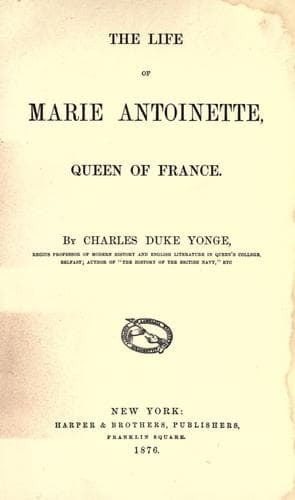
The Life of Marie Antoinette, Queen of FranceYonge, Charles Duke
History
The Life of Marie Antoinette, Queen of France
Yonge, Charles Duke
Marie Antoinette, Queen, consort of Louis XVI, King of France, 1755-1793
Marie Antoinette had, therefore, difficulties and enemies to contend with
from the very first commencement of her residence in France. And many even
of her own virtues were unfavorable to her chances of happiness,
calculated as they were to lay her at the mercy of her ill-wishers, and to
deprive her of some of the defenses which might have been found in a
different temperament. Full of health and spirits, she was naturally eager
in the pursuit of enjoyment, and anxious to please every one, from feeling
nothing but kindness toward every one; she was frank, open, and sincere;
and, being perfectly guileless herself, she was, as through her whole life
she continued to be, entirely unsuspicious of unfriendliness, much more of
treachery in others. Her affability and condescension combined with this
trustful disposition to make her too often the tool of designing and
grasping courtiers, who sought to gain their own ends at her expense, and
who presumed on her good-nature and inexperience to make requests which,
as they well knew, should never have been made, but which they also
reckoned that she would be unwilling to refuse.
But lest this general amiability and desire to give pleasure to those
around her might seem to impart a prevailing tinge of weakness to her
character, it is fair to add that she united to these softer feelings,
robuster virtues calculated to deserve and to win universal admiration;
though some of them, never having yet been called forth by circumstances,
were for a long time unsuspected by the world at large. She had pride--
pride of birth, pride of rank--though never did that feeling show itself
more nobly or more beneficially. It never led her to think herself above
the very meanest of her subjects. It never made her indifferent to the
interests, to the joys or sorrows, of a single individual. The idea with
which it inspired her was, that a princess of her race was never to commit
an unworthy act, was never to fail in purity of virtue, in truth, in
courage; that she was to be careful to set an example of these virtues to
those who would naturally look up to her; and that she herself was to keep
constantly in her mind the example of her illustrious mother, and never,
by act, or word, or thought, to discredit her mother's name. And as she
thus regarded courage as her birthright, so she possessed it in abundance
and in variety. She had courage to plan, and courage to act; courage to
resolve, and courage to adhere to the resolution once deliberately formed;
and, above all, courage to endure and to suffer, and, in the very
extremity of misery, to animate and support others less royally endowed.
Public-domain text, read in full here on John Shaqi.
Reviews
Reviews
No reviews yet
Be the first to share your thoughts on this work.
Join the Discussion
Join the discussion
Sign in to leave a comment or review.
Sign InorCreate an account