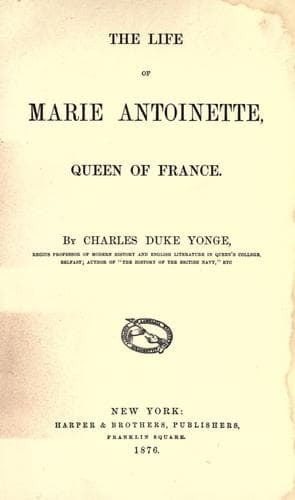
The Life of Marie Antoinette, Queen of FranceYonge, Charles Duke
History
The Life of Marie Antoinette, Queen of France
Yonge, Charles Duke
Marie Antoinette, Queen, consort of Louis XVI, King of France, 1755-1793
One other detail in the accounts of Marie Antoinette's conduct, which from
time to time reached Vienna, had also vexed the empress, and it should be
kept in mind by any one who would fairly estimate the truth of the charge
brought against her, and urged with such rancor after she had become
queen--of postponing the interests of France to those of her native land,
of being Austrian at heart. Maria Teresa had heard, on the contrary, that
she had given those Austrians who had presented themselves at Versailles
but a cold reception, and she did not attempt to conceal her discontent.
With a natural and becoming pride in and jealousy for her own loyal and
devoted subjects, she entreated her daughter never to feel ashamed of
them, or ashamed of being German herself, even if, comparatively speaking,
the name should imply some deficiency in polish. "The French themselves
would esteem her more if they saw in her something of German solidity and
frankness.[5]"
The daughter answered the mother with some adroitness. She took no notice
of the advice about her behavior to Madame du Barri. It was the one topic
on which her own feelings of propriety, as well as those of the dauphin,
coincided with the suggestions of the aunts, and she did not desire to vex
or provoke the empress by a prolonged discussion of the question; but the
charge of coldness to her own countrymen she denied earnestly. "She should
always glory in being a German. Some of those nobles whom the empress had
expressly named she had treated with careful distinction, and had even
danced with them, though they were not men of the very highest character.
She well knew that the Germans had many good qualities which she could
wish that the French shared with them;" and she promised that, whenever
any of her mother's subjects of such standing and merit as to be worthy of
her attention came to the court, they should have no cause to complain of
her reception of them. Her language on the subject is so measured and
careful as to lead us almost inevitably to the inference that the reports
which had excited such dissatisfaction at Vienna were not without
foundation, but that the French gayety, even if often descending to
frivolity, was more to her taste than the German solidity which her mother
so highly esteemed, and that she had been at no great pains to hide a
preference which must naturally he acceptable to those among whom her
future life was to be spent.
Public-domain text, read in full here on John Shaqi.
Reviews
Reviews
No reviews yet
Be the first to share your thoughts on this work.
Join the Discussion
Join the discussion
Sign in to leave a comment or review.
Sign InorCreate an account