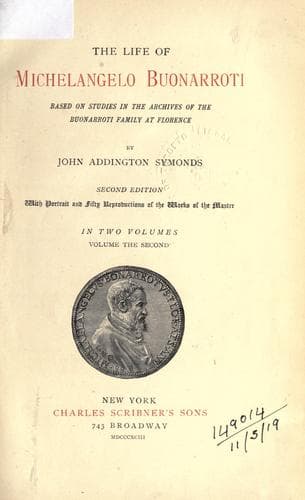
The Life of Michelangelo BuonarrotiSymonds, John Addington
History
The Life of Michelangelo Buonarroti
Symonds, John Addington
Michelangelo Buonarroti, 1475-1564
M. Charles Gamier, in _L'OEuvre et la Vie_, speaking with the
authority of a practical architect, says: "Michelangelo was not,
properly speaking, an architect. He made architecture, which is quite
a different thing; and most often it was the architecture of a painter
and sculptor, which points to colour, breadth, imagination, but also
to insufficient studies and incomplete education. The thought may be
great and strong, but the execution of it is always feeble and
naïve.... He had not learned the language of the art. He has all the
qualities of imagination, invention, will, which form a great
composer; but he does not know the grammar, and can hardly write....
In seeking the great, he has too often found the tumid; seeking the
original, he has fallen upon the strange, and also on bad taste."
There is much that is true in this critique, severe though it may seem
to be. The fact is that Michelangelo aimed at picturesque effect in
his buildings; not, as previous architects had done, by a lavish use
of loosely decorative details, but by the piling up and massing
together of otherwise dry orders, cornices, pilasters, windows, all of
which, in his conception, were to serve as framework and pedestals for
statuary. He also strove to secure originality and to stimulate
astonishment by bizarre modulations of accepted classic forms, by
breaking the lines of architraves, combining angularities with curves,
adopting a violently accented rhythm and a tortured multiplicity of
parts, wherever this was possible.
V
In this new style, so much belauded by Vasari, the superficial design
is often rich and grandiose, making a strong pictorial appeal to the
imagination. Meanwhile, the organic laws of structure have been
sacrificed; and that chaste beauty which emerges from a perfectly
harmonious distribution of parts, embellished by surface decoration
only when the limbs and members of the building demand emphasis, may
be sought for everywhere in vain. The substratum is a box, a barn, an
inverted bottle; built up of rubble, brick, and concrete; clothed with
learned details, which have been borrowed from the pseudo-science of
the humanist. There is nothing here of divine Greek candour, of
dominant Roman vigour, of Gothic vitality, of fanciful invention
governed by a sincere sense of truth. Nothing remains of the shy
graces, the melodious simplicities, the pure seeking after musical
proportion, which marked the happier Italian effort of the early
Renaissance, through Brunelleschi and Alberti, Bramante, Giuliano da
Sangallo, and Peruzzi. Architecture, in the highest sense of that
word, has disappeared. A scenic scheme of panelling for empty walls
has superseded the conscientious striving to construct a living and
intelligible whole.
Public-domain text, read in full here on John Shaqi.
Reviews
Reviews
No reviews yet
Be the first to share your thoughts on this work.
Elsewhere in the archive
Join the Discussion
Join the discussion
Sign in to leave a comment or review.
Sign InorCreate an account