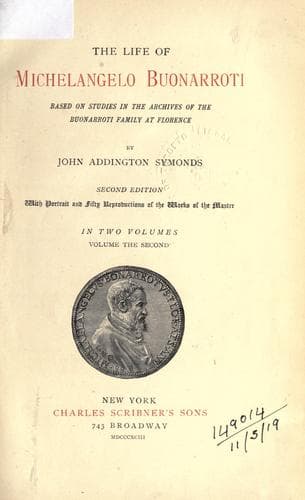
The Life of Michelangelo BuonarrotiSymonds, John Addington
History
The Life of Michelangelo Buonarroti
Symonds, John Addington
Michelangelo Buonarroti, 1475-1564
The fault inherent in Italian building after the close of the Lombard
period, reaches its climax here. That fault was connected with the
inability of the Italians to assimilate the true spirit of the Gothic
style, while they attempted its imitation in practice. The fabrication
of imposing and lovely façades at Orvieto, at Siena, at Cremona, and
at Crema, glorious screens which masked the poverty of the edifice,
and corresponded in no point to the organism of the structure, taught
them to overrate mere surface-beauty. Their wonderful creativeness in
all the arts which can be subordinated to architectural effect seduced
them further. Nothing, for instance, taken by itself alone, can be
more satisfactory than the façade of the Certosa at Pavia; but it is
not, like the front of Chartres or Rheims or Amiens, a natural
introduction to the inner sanctuary. At the end of the Gothic period
architecture had thus come to be conceived as the art of covering
shapeless structures with a wealth of arabesques in marble, fresco,
bronze, mosaic.
The revival of learning and a renewed interest in the antique withdrew
the Italians for a short period from this false position. With more or
less of merit, successive builders, including those I have above
mentioned, worked in a pure style: pure because it obeyed the laws of
its own music, because it was intelligible and self-consistent, aiming
at construction as the main end, subordinating decoration of richer
luxuriance or of sterner severity to the prime purpose of the total
scheme. But this style was too much the plaything of particular minds
to create a permanent tradition. It varied in the several provinces of
Italy, and mingled personal caprice with the effort to assume a
classic garb. Meanwhile the study of Vitruvius advanced, and that
pedantry which infected all the learned movements of the Renaissance
struck deep and venomous roots into the art of building.
Public-domain text, read in full here on John Shaqi.
Reviews
Reviews
No reviews yet
Be the first to share your thoughts on this work.
Elsewhere in the archive
Join the Discussion
Join the discussion
Sign in to leave a comment or review.
Sign InorCreate an account