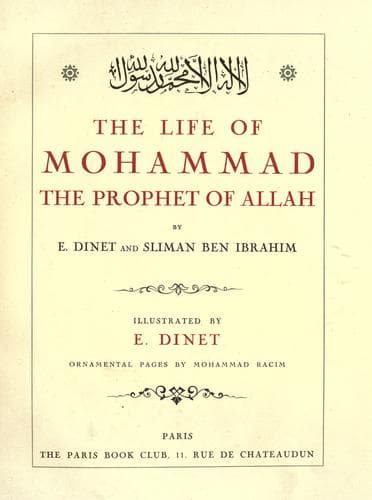
The Life of Mohammad, the Prophet of AllahDinet, Etienne
Religion
The Life of Mohammad, the Prophet of Allah
Dinet, Etienne
Muhammad, Prophet, -632
After the return of his victorious lieutenants, the Prophet despatched
missionaries to the newly-converted tribes, in order to prevent them
backsliding by introducing any of their past superstitions into the
religion.
One of the principal missionaries was Mu'adh ibn Jabal, who was about
to set out for the Yaman. So that all should see the consideration he
attached to the mission entrusted to Mu'adh, the Prophet bound a
turban round his envoy's head, helped him to mount his camel, and
walked by the animal's side, giving final instructions. Mu'adh
confused, made as if to alight, but Mohammad stopped him. 'Remain in
the saddle, O sincere friend!' he said. 'I follow the orders of Heaven
and satisfy my heart. It is needful that a man performing important
duties should be honoured. Ah! if only I had hopes of seeing thee
again, I should cut our conversation short; but probably I now speak
to thee for the last time.' Much moved, they separated; never to meet
again in this world....
In the month of Zu'l-Qa'dah, the Apostle, ever mindful of the
religious and political importance of the pilgrimage to Makkah, sent
Abu Bakr to accomplish it at the head of three hundred Mussulmans.
Scarcely had Abu Bakr reached Zu'l Holifah, when the Surah of
"Bara'ah" was revealed:
"_O Believers! only they who join gods with Allah (that is to say,
those who in any way whatsoever, associate Allah the Only One with
other divinities or persons) are unclean! Let them not therefore,
after this their year, come near the Sacred Temple (of Makkah)._" (THE
QUR'AN, IX, 28.)
This Surah, remarkable as being the only one in the Qur'an without the
introductory form: "In the name of Allah, the Merciful, the
Compassionate," was of the greatest importance, in so far as the
pilgrimage was concerned. It forbid all who were not Mussulmans from
setting foot in Holy Territory and even nowadays this prohibition
being rigorously enforced, the pilgrims of Islam are safeguarded
against enemy spies, and protected from the unseemly curiosity of
foreigners.
This was also the final blow struck at idolatry among the Arabs who
could no longer come to Makkah unless they disowned their idols.
Consequently, the Prophet charged Ali to rejoin the pilgrims' caravan
in all haste and recite this imperative Surah to the assembled
Faithful, after the sacrifices had been made in the valley of Mina.
[Sidenote: THE VALEDICTORY PILGRIMAGE (_Zul-Hijjah, in Year X of the
Hegira, March A.D. 632_)]
Public-domain text, read in full here on John Shaqi.
Reviews
Reviews
No reviews yet
Be the first to share your thoughts on this work.
Elsewhere in the archive
Join the Discussion
Join the discussion
Sign in to leave a comment or review.
Sign InorCreate an account