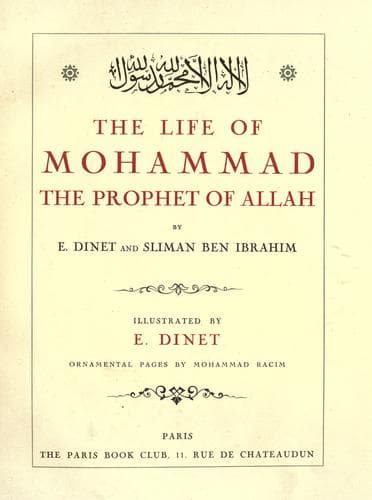
The Life of Mohammad, the Prophet of Allah — John Shaqi
The Life of Mohammad, the Prophet of AllahDinet, Etienne
Religion
The Life of Mohammad, the Prophet of Allah
Dinet, Etienne
Muhammad, Prophet, -632
After partial destruction by fire, the Ka'bah had been badly restored.
The roof fell in, and thieves took advantage of the breach to get into
the Sanctuary and carry off part of the treasure, constituted by
pilgrims' offerings.
Fresh repairs were urgently needed; but as bad luck would have it, the
walls were so dilapidated that they could no longer bear the least
weight. There was nothing to be done but to raze them to the ground.
If, however, the idea of rebuilding such a revered monument met with
no objection, its demolition seemed to be the most dangerous sacrilege
imaginable.
After much hesitation, finally dispelled by a series of obvious
miracles, the Quraish men came to the resolution of tearing down the
old walls of which the remains were in heaps on the ground. Then, as
the ancient foundations were formed of blocks of stone admirably
fitting one into the other, each clan of the Quraish tribe undertook
part of the task of rebuilding.
The workers, actuated by the zeal that always arises from rivality,
soon built up the walls to the height at which the famous Black Stone,
"al-Hajaru'l-Aswad," should be fixed. Who was to have the honour of
putting the precious relic back in its place? There was not the
slightest chance of coming to an agreement on this point, and, in
consequence of each party pleading the precedence of the purest noble
descent or the greatest merit, the discussion grew so heated that most
tragical results were to be feared. Under the influence of jealousy,
groups were formed and stood face to face. The Bani Abed-Dar, joining
the Bani Adiyy bin Kab, brought forth a bowl filled with blood,
plunging their hands therein, and swearing they would die sooner than
relinquish the privilege in anyone else's favour, because they thought
it devolved upon them by right.
For four days and four nights, the adversaries, with threatening mien,
remained on the look-out, absorbed in the task of vigilantly watching
each other. At last, Abu-Ummayah, their senior, spoke out, saying:
'There will come a time when all this must finish and this is what I
propose: name as umpire the first man who cometh into our midst, and
let him settle the dispute that destroyeth our union.'
The advice given was not displeasing to the stubborn rivals and they
finally agreed to follow it. It happened then, at that very moment,
that they saw coming towards them a young man about thirty years of
age. They recognised him as "Al-Amin" (The Reliable); in other words:
Mohammad. Nothing could have been more fortunate, and all being as of
one mind on this point, they accepted him as arbitrator at once,
submitting the cause of their conflict to his judgment. When they
terminated explaining the case, Mohammad, instead of hearkening to
their respective claims, only said: 'Bring a mantle and spread it out
on the ground.'
Public-domain text, read in full here on John Shaqi.
Reviews
Reviews
No reviews yet
Be the first to share your thoughts on this work.
Join the Discussion
Join the discussion
Sign in to leave a comment or review.
Sign InorCreate an account