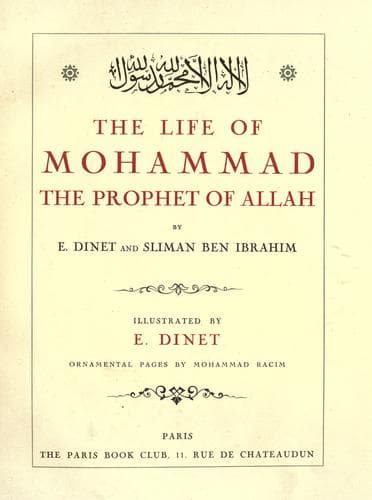
The Life of Mohammad, the Prophet of AllahDinet, Etienne
Religion
The Life of Mohammad, the Prophet of Allah
Dinet, Etienne
Muhammad, Prophet, -632
When they had obeyed his behest, he took the Black Stone in his hands
and placing it in the middle of the cloak, he went on: 'Let the most
influential person of each party take hold of the mantle by the corner
that is in front of him.' All did as they were told, and then he
turned towards those who held the corners of the mantle. 'Now, lift
the cloak,' he continued; 'all together, up to the height of the wall
which is being built.'
They obeyed and when the lifted cloak was level with the spot where
the Black Stone was to be built in, Mohammad took the Relic and with
his own hands, put it in its place.
Thanks to his presence of mind, all cause of discord disappeared. He
had given satisfaction to each of the rival groups, without favouring
one more than the other; and caused the proud Arabs to be reconciled
without bloodshed, for the first time in all their history; in short,
there was honour due to him which no one contested.
High above the Black Stone, the walls rose rapidly, carried up by the
workers toiling as friends. The ribs of a ship wrecked on the Jeddah
coast furnished a flat terrace-roof, and when the monument was
finished, it was entirely draped with a veil of the finest lawn, woven
by the Copts.
In later years, the veil consisted of striped Yaman cloth; and still
later, the Ka'bah was covered by Hajaj bin Yusef with the "Kiswah," or
garment of black silk, such as is still thrown over it at the present
day, being renewed yearly.
[Illustration: (Calligraphy) _And provide for your journey; but the
best provision is the fear of Allah._]
[Illustration: (Ornamental page) CHAPTER THE THIRD]
[Illustration: _"At Takbir", or Glorification._]
[Illustration: (Calligraphy) _Verily, we have caused It (the Qur'an)
to descend on the night of Power._]
CHAPTER THE THIRD
[Sidenote: DESERT RETIREMENT]
To him they called "Al-Amin," (the Reliable), his fellow-citizens were
ready to grant the highest and most coveted honours, with a post of
preponderance in their city.
But being of a disposition equally devoid of vanity or ambition, he
disdainfully refused to reply to their flattering advances, and his
fortuitous intervention in the dispute arising from the rebuilding of
the Ka'bah was the only time he was mixed up with public affairs
during a period of fifteen years, dating from his wedding-day.
How did he pass his time? Allah had inspired him with the love of
solitude, and Mohammad loved more than anything to wander all alone on
great empty plains stretching away farther than the eye could reach.
What were the causes of this liking? Doubtless, in the gloomy desert
surrounding Makkah, he conjured up over and over again the delightful
memories of his childhood, passed in the Badya; but his highly-gifted
soul found satisfaction of a more exalted kind. In the first place, he
was spared the sight of the moral and religious errors of the Arabs at
that period.
Public-domain text, read in full here on John Shaqi.
Reviews
Reviews
No reviews yet
Be the first to share your thoughts on this work.
Join the Discussion
Join the discussion
Sign in to leave a comment or review.
Sign InorCreate an account