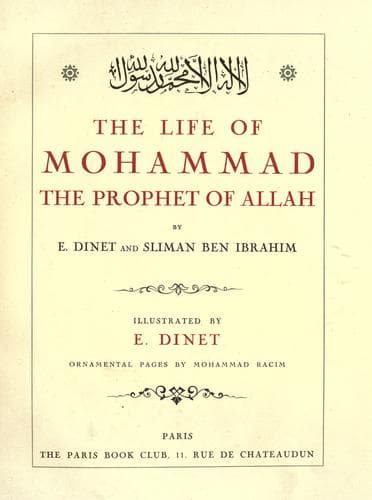
The Life of Mohammad, the Prophet of Allah — John Shaqi
The Life of Mohammad, the Prophet of AllahDinet, Etienne
Religion
The Life of Mohammad, the Prophet of Allah
Dinet, Etienne
Muhammad, Prophet, -632
The Arabs were, in the highest degree, aristocratic, proud,
independent and courageous. Their generosity towards their guests was
exemplified in a refined manner that has never been surpassed; and,
among them, a certain Hatim Tay may be looked upon as the Prince of
Generous Hosts.
By their natural gifts of eloquence and poetry, they can bear
comparison with the most brilliant orators or magnificent poets of the
universe. Their poetry, above all, allowing them to celebrate heroic
exploits; and their open-minded generosity by which they were led to
sing love's joy and sadness, became, for such hot-blooded men, the
object of passionate adoration, marvellously well served by the most
enchanting language ever known.
Their public fairs, particularly that held at Okaz, furnished an
opportunity for real poetical contests, where the winner heard his
poem applauded by a madly delighted throng, and then it was written
out fully in letters of gold, and hung up in the Temple of the Ka'bah.
Of these poetical triumphs, called "Al-Muaalaquate," ("The
Suspended"), seven have been handed down to us and prove what great
heights were attained by the genius of the Bedouin primitive poets.
But, at the same time as we admire such brilliant qualities innate in
the Arabs, we have to deplore great errors. The monotheistic religion
of their great ancestor Ibrahim (Abraham) was entirely forgotten,
despite their continued veneration for the Temple built with their own
hands. They had become "Mushrikun," ("Associates"). To Allah, the Only
One, partners were adjoined in the shape of idols, who were generally
preferred. Every tribe and family possessed a favourite idol; and, at
that epoch, three hundred and sixty false gods, of wood or stone,
dishonoured the Holy Ka'bah.
The most gross superstition flourished in addition to idolatry. Games
of chance, divining by arrows, drunkenness and sorcery debased the
brains of these men, all otherwise remarkably gifted. Fretting under
all restraint, lacking all ideas of decency, they married as many
women as they could afford to feed; and as widows were considered to
belong to their husbands' estate, revolting unions took place between
stepmothers and stepsons.
Still more abominable was the custom of the "Wa'du'l-Binat," (Burying
Girls Alive). By some strange morbid decay of the feeling of honour,
and also through fear that the debauchery of daughters or their
capture by an enemy might one day bring opprobrium on their families,
many unnatural fathers preferred to get rid of their female offspring,
by burying them alive as soon as they were born.
To sum up: the Arabs' leaning towards ostentation, their aristocratic
prejudice and overweening pride, caused them to rebel against all
discipline or authority. Consequently, union and progress becoming
impossible, incessant warfare and pitiless vendettas between tribes
and families submerged all Arabia in a sea of blood.
Public-domain text, read in full here on John Shaqi.
Reviews
Reviews
No reviews yet
Be the first to share your thoughts on this work.
Join the Discussion
Join the discussion
Sign in to leave a comment or review.
Sign InorCreate an account