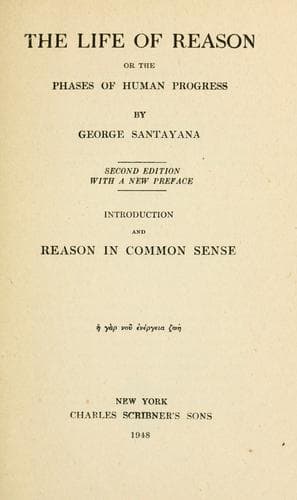
The Life of Reason: The Phases of Human ProgressSantayana, George
Philosophy
The Life of Reason: The Phases of Human Progress
Santayana, George
Philosophy
Such assertions, coming from lordly lips, have a suspicious optimism
about them; yet the faithful slave, such as the nurse we find in the
tragedies, may sometimes have corresponded to that description. In other
regions it is surely true that to advance in conventional station would
often entail a loss in true dignity and happiness. It would seldom
benefit a musician to be appointed admiral or a housemaid to become a
prima donna. Scientific breeding might conceivably develop much more
sharply the various temperaments and faculties needed in the state; and
then each caste or order of citizens would not be more commonly
dissatisfied with its lot than men or women now are with their sex. One
tribe would run errands as persistently as the ants; another would sing
like the lark; a third would show a devil’s innate fondness for stoking
a fiery furnace.
[Sidenote: Its falsity.]
Aristocracy logically involves castes. But such castes as exist in
India, and the social classes we find in the western world, are not now
based on any profound difference in race, capacity, or inclination. They
are based probably on the chances of some early war, reinforced by
custom and perpetuated by inheritance. A certain circulation,
corresponding in part to proved ability or disability, takes place in
the body politic, and, since the French Revolution, has taken place
increasingly. Some, by energy and perseverance, rise from the bottom;
some, by ill fortune or vice, fall from the top. But these readjustments
are insignificant in comparison with the social inertia that perpetuates
all the classes, and even such shifts as occur at once re-establish
artificial conditions for the next generation. As a rule, men’s station
determines their occupation without their gifts determining their
station. Thus stifled ability in the lower orders, and apathy or
pampered incapacity in the higher, unite to deprive society of its
natural leaders.
[Sidenote: Feeble individuality the rule.]
It would be easy, however, to exaggerate the havoc wrought by such
artificial conditions. The monotony we observe in mankind must not be
charged to the oppressive influence of circumstances crushing the
individual soul. It is not society’s fault that most men seem to miss
their vocation. Most men have no vocation; and society, in imposing on
them some chance language, some chance religion, and some chance career,
first plants an ideal in their bosoms and insinuates into them a sort of
racial or professional soul. Their only character is composed of the
habits they have been led to acquire. Some little propensities betrayed
in childhood may very probably survive; one man may prove by his dying
words that he was congenitally witty, another tender, another brave.
But these native qualities will simply have added an ineffectual tint to
some typical existence or other; and the vast majority will remain, as
Schopenhauer said, _Fabrikwaaren der Natur_.
Public-domain text, read in full here on John Shaqi.
Reviews
Reviews
No reviews yet
Be the first to share your thoughts on this work.
Elsewhere in the archive
Join the Discussion
Join the discussion
Sign in to leave a comment or review.
Sign InorCreate an account