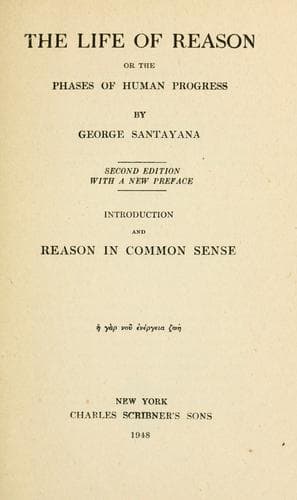
The Life of Reason: The Phases of Human ProgressSantayana, George
Philosophy
The Life of Reason: The Phases of Human Progress
Santayana, George
Philosophy
Variety in human dreams, like personality among savages, may indeed be
inwardly very great, but it is not efficacious. To be socially important
and expressible in some common medium, initial differences in temper
must be organised into custom and become cumulative by being imitated
and enforced. The only artists who can show great originality are those
trained in distinct and established schools; for originality and genius
must be largely fed and raised on the shoulders of some old tradition. A
rich organisation and heritage, while they predetermine the core of all
possible variations, increase their number, since every advance opens up
new vistas; and growth, in extending the periphery of the substance
organised, multiplies the number of points at which new growths may
begin. Thus it is only in recent times that discoveries in science have
been frequent, because natural science until lately possessed no settled
method and no considerable fund of acquired truths. So, too, in
political society, statesmanship is made possible by traditional
policies, generalship by military institutions, great financiers by
established commerce.
If we ventured to generalise these observations we might say that such
an unequal distribution of capacity as might justify aristocracy should
be looked for only in civilised states. Savages are born free and equal,
but wherever a complex and highly specialised environment limits the
loose freedom of those born into it, it also stimulates their capacity.
Under forced culture remarkable growths will appear, bringing to light
possibilities in men which might, perhaps, not even have been
possibilities had they been left to themselves; for mulberry leaves do
not of themselves develop into brocade. A certain personal idiosyncrasy
must be assumed at bottom, else cotton damask would be as good as silk
and all men having like opportunities would be equally great. This
idiosyncrasy is brought out by social pressure, while in a state of
nature it might have betrayed itself only in trivial and futile ways, as
it does among barbarians.
[Sidenote: Sophistical envy.]
Public-domain text, read in full here on John Shaqi.
Reviews
Reviews
No reviews yet
Be the first to share your thoughts on this work.
Elsewhere in the archive
Join the Discussion
Join the discussion
Sign in to leave a comment or review.
Sign InorCreate an account