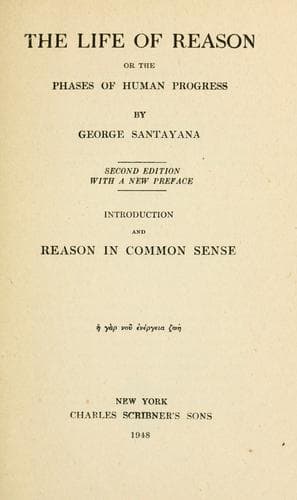
The Life of Reason: The Phases of Human ProgressSantayana, George
Philosophy
The Life of Reason: The Phases of Human Progress
Santayana, George
Philosophy
Distinction is thus in one sense artificial, since it cannot become
important or practical unless a certain environment gives play to
individual talent and preserves its originality; but distinction
nevertheless is perfectly real, and not merely imputed. In vain does the
man in the street declare that he, too, could have been a king if he had
been born in the purple; for that potentiality does not belong to him as
he is, but only as he might have been, if _per impossibile_ he had not
been himself. There is a strange metaphysical illusion in imagining that
a man might change his parents, his body, his early environment, and
yet retain his personality. In its higher faculties his personality is
produced by his special relations. If Shakespeare had been born in Italy
he might, if you will, have been a great poet, but Shakespeare he could
never have been. Nor can it be called an injustice to all of us who are
not Englishmen of Queen Elizabeth’s time that Shakespeare had that
advantage and was thereby enabled to exist.
The sense of injustice at unequal opportunities arises only when the two
environments compared are really somewhat analogous, so that the
illusion of a change of rôles without a change of characters may retain
some colour. It was a just insight, for instance, in the Christian fable
to make the first rebel against God the chief among the angels, the
spirit occupying the position nearest to that which he tried to usurp.
Lucifer’s fallacy consisted in thinking natural inequality artificial.
His perversity lay in rebelling against himself and rejecting the
happiness proper to his nature. This was the maddest possible way of
rebelling against his true creator; for it is our particular finitude
that creates us and makes us be. No one, except in wilful fancy, would
envy the peculiar advantages of a whale or an ant, of an Inca or a Grand
Lama. An exchange of places with such remote beings would too evidently
leave each creature the very same that it was before; for after a
nominal exchange of places each office would remain filled and no trace
of a change would be perceptible. But the penny that one man finds and
another misses would not, had fortune been reversed, have transmuted
each man into the other. So adventitious a circumstance seems easily
transferable without undermining that personal distinction which it had
come to embitter. Yet the incipient fallacy lurking even in such
suppositions becomes obvious when we inquire whether so blind an
accident, for instance, as sex is also adventitious and ideally
transferable and whether Jack and Jill, remaining themselves, could have
exchanged genders.
Public-domain text, read in full here on John Shaqi.
Reviews
Reviews
No reviews yet
Be the first to share your thoughts on this work.
Elsewhere in the archive
Join the Discussion
Join the discussion
Sign in to leave a comment or review.
Sign InorCreate an account