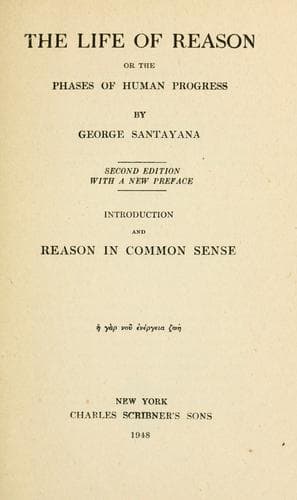
The Life of Reason: The Phases of Human ProgressSantayana, George
Philosophy
The Life of Reason: The Phases of Human Progress
Santayana, George
Philosophy
What extends these invidious comparisons beyond all tolerable bounds is
the generic and vague nature proper to language and its terms. The first
personal pronoun “I” is a concept so thoroughly universal that it can
accompany any experience whatever, yet it is used to designate an
individual who is really definable not by the formal selfhood which he
shares with every other thinker, but by the special events that make up
his life. Each man’s memory embraces a certain field, and if the
landscape open to his vision is sad and hateful he naturally wishes it
to shift and become like that paradise in which, as he fancies, other
men dwell. A legitimate rebellion against evil in his own experience
becomes an unthinkable supposition about what his experience might have
been had _he_ enjoyed those other men’s opportunities or even (so far
can unreason wander) had _he_ possessed their character. The wholly
different creature, a replica of that envied ideal, which would have
existed in that case would still have called itself “I”; and so, the
dreamer imagines, that creature would have been himself in a different
situation.
If a new birth could still be called by a man’s own name, the reason
would be that the concrete faculties now present in him are the basis
for the ideal he throws out, and if these particular faculties came to
fruition in a new being, he would call that being himself, inasmuch as
it realised his ideal. The poorer the reality, therefore, the meaner and
vaguer the ideal it is able to project. Man is so tied to his personal
endowment (essential to him though an accident in the world) that even
his uttermost ideal, into which he would fly out of himself and his
finitude, can be nothing but the fulfilment of his own initial
idiosyncrasies. Whatever other wills and other glories may exist in
heaven lie not within his universe of aspiration. Even his most
perversely metaphysical envy can begrudge to others only what he
instinctively craves for himself.
[Sidenote: Inequality is not a grievance; suffering is.]
Public-domain text, read in full here on John Shaqi.
Reviews
Reviews
No reviews yet
Be the first to share your thoughts on this work.
Elsewhere in the archive
Join the Discussion
Join the discussion
Sign in to leave a comment or review.
Sign InorCreate an account