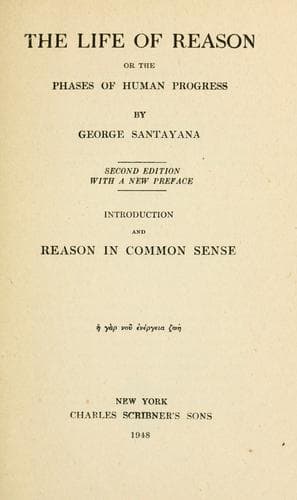
The Life of Reason: The Phases of Human ProgressSantayana, George
Philosophy
The Life of Reason: The Phases of Human Progress
Santayana, George
Philosophy
It is not mere inequality, therefore, that can be a reproach to the
aristocratic or theistic ideal. Could each person fulfil his own nature
the most striking differences in endowment and fortune would trouble
nobody’s dreams. The true reproach to which aristocracy and theism are
open is the thwarting of those unequal natures and the consequent
suffering imposed on them all. Injustice in this world is not something
comparative; the wrong is deep, clear, and absolute in each private
fate. A bruised child wailing in the street, his small world for the
moment utterly black and cruel before him, does not fetch his
unhappiness from sophisticated comparisons or irrational envy; nor can
any compensations and celestial harmonies supervening later ever expunge
or justify that moment’s bitterness. The pain may be whistled away and
forgotten; the mind may be rendered by it only a little harder, a little
coarser, a little more secretive and sullen and familiar with
unrightable wrong. But ignoring that pain will not prevent its having
existed; it must remain for ever to trouble God’s omniscience and be a
part of that hell which the creation too truly involves.
[Sidenote: Mutilation by crowding.]
The same curse of suffering vitiates Agrippa’s ingenious parable and the
joyful humility of Dante’s celestial friends, and renders both equally
irrelevant to human conditions. Nature may arrange her hierarchies as
she chooses and make her creatures instrumental to one another’s life.
That interrelation is no injury to any part and an added beauty in the
whole. It would have been a truly admirable arrangement to have enabled
every living being, in attaining its own end, to make the attainments of
the others’ ends possible to them also. An approach to such an
equilibrium has actually been reached in some respects by the rough
sifting of miscellaneous organisms until those that were compatible
alone remained. But nature, in her haste to be fertile, wants to produce
everything at once, and her distracted industry has brought about
terrible confusion and waste and terrible injustice. She has been led to
punish her ministers for the services they render and her favourites for
the honours they receive. She has imposed suffering on her creatures
together with life; she has defeated her own objects and vitiated her
bounty by letting every good do harm and bring evil in its train to some
unsuspecting creature.
Public-domain text, read in full here on John Shaqi.
Reviews
Reviews
No reviews yet
Be the first to share your thoughts on this work.
Elsewhere in the archive
Join the Discussion
Join the discussion
Sign in to leave a comment or review.
Sign InorCreate an account