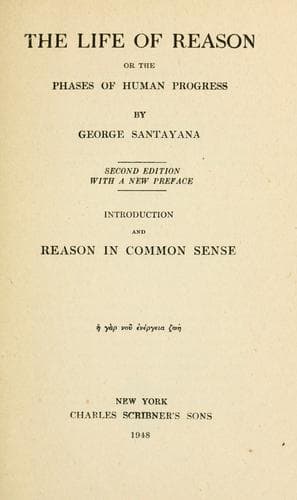
The Life of Reason: The Phases of Human ProgressSantayana, George
Philosophy
The Life of Reason: The Phases of Human Progress
Santayana, George
Philosophy
The highest form of vanity is love of fame. It is a passion easy to
deride but hard to understand, and in men who live at all by imagination
almost impossible to eradicate. The good opinion of posterity can have
no possible effect on our fortunes, and the practical value which
reputation may temporarily have is quite absent in posthumous fame. The
direct object of this passion—that a name should survive in men’s
mouths to which no adequate idea of its original can be attached—seems
a thin and fantastic satisfaction, especially when we consider how
little we should probably sympathise with the creatures that are to
remember us. What comfort would it be to Virgil that boys still read him
at school, or to Pindar that he is sometimes mentioned in a world from
which everything he loved has departed? Yet, beneath this desire for
nominal longevity, apparently so inane, there may lurk an ideal ambition
of which the ancients cannot have been unconscious when they set so high
a value on fame. They often identified fame with immortality, a subject
on which they had far more rational sentiments than have since
prevailed.
[Sidenote: Its possible ideality.]
Fame, as a noble mind conceives and desires it, is not embodied in a
monument, a biography, or the repetition of a strange name by strangers;
it consists in the immortality of a man’s work, his spirit, his
efficacy, in the perpetual rejuvenation of his soul in the world. When
Horace—no model of magnanimity—wrote his _exegi monumentum_, he was
not thinking that the pleasure he would continue to give would remind
people of his trivial personality, which indeed he never particularly
celebrated and which had much better lie buried with his bones. He was
thinking, of course, of that pleasure itself; thinking that the delight,
half lyric, half sarcastic, which those delicate cameos had given him
to carve would be perennially renewed in all who retraced them. Nay,
perhaps we may not go too far in saying that even that impersonal
satisfaction was not the deepest he felt; the deepest, very likely,
flowed from the immortality, not of his monument, but of the subject and
passion it commemorated; that tenderness, I mean, and that disillusion
with mortal life which rendered his verse immortal. He had expressed,
and in expressing appropriated, some recurring human moods, some mocking
renunciations; and he knew that his spirit was immortal, being linked
and identified with that portion of the truth. He had become a little
spokesman of humanity, uttering what all experience repeats more or less
articulately; and even if he should cease to be honoured in men’s
memories, he would continue to be unwittingly honoured and justified in
their lives.
Public-domain text, read in full here on John Shaqi.
Reviews
Reviews
No reviews yet
Be the first to share your thoughts on this work.
Elsewhere in the archive
Join the Discussion
Join the discussion
Sign in to leave a comment or review.
Sign InorCreate an account