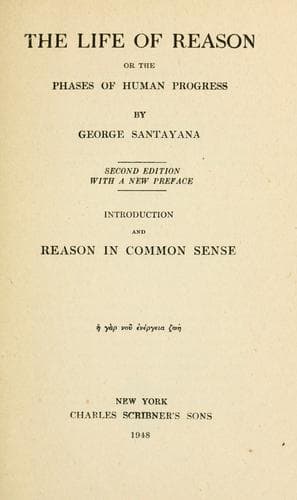
The Life of Reason: The Phases of Human ProgressSantayana, George
Philosophy
The Life of Reason: The Phases of Human Progress
Santayana, George
Philosophy
A man is sometimes a coloured and sometimes a clear medium for the
energies he exerts. When a thought conveyed or a work done enters alone
into the observer’s experience, no friendship is possible. This is
always the case when the master is dead; for if his reconstructed
personality retains any charm, it is only as an explanation or conceived
nexus for the work he performed. In a philosopher or artist, too,
personality is merely instrumental, for, although in a sense pervasive,
a creative personality evaporates into its expression, and whatever part
of it may not have been translated into ideas is completely negligible
from the public point of view. That portion of a man’s soul which he has
not alienated and objectified is open only to those who know him
otherwise than by his works and do not estimate him by his public
attributions. Such persons are his friends. Into their lives he has
entered not merely through an idea with which his name may be
associated, nor through the fame of some feat he may have performed, but
by awakening an inexpressible animal sympathy, by the contagion of
emotions felt before the same objects. Estimation has been partly
arrested at its medium and personal relations have added their homely
accent to universal discourse. Friendship might thus be called ideal
sympathy refracted by a human medium, or comradeship and sensuous
affinity colouring a spiritual light.
[Sidenote: The medium must also be transparent.]
If we approach friendship from above and compare it with more ideal
loyalties, its characteristic is its animal warmth and its basis in
chance conjunctions; if we approach it from below and contrast it with
mere comradeship or liking, its essence seems to be the presence of
common ideal interests. That is a silly and effeminate friendship in
which the parties are always thinking of the friendship itself and of
how each stands in the other’s eyes; a sentimental fancy of that sort,
in which nothing tangible or ulterior brings people together, is rather
a feeble form of love than properly a friendship. In extreme youth such
a weakness may perhaps indicate capacity for friendship of a nobler
type, because when taste and knowledge have not yet taken shape, the
only way, often, in which ideal interests can herald themselves is in
the guise of some imagined union from which it is vaguely felt they
might be developed, just as in love sexual and social instincts mask
themselves in an unreasoning obsession, or as for mystic devotion every
ideal masks itself in God. All these sentimental feelings are at any
rate mere preludes, but preludes in fortunate cases to more
discriminating and solid interests, which such a tremulous overture may
possibly pitch on a higher key.
[Sidenote: Common interests indispensable.]
Public-domain text, read in full here on John Shaqi.
Reviews
Reviews
No reviews yet
Be the first to share your thoughts on this work.
Elsewhere in the archive
Join the Discussion
Join the discussion
Sign in to leave a comment or review.
Sign InorCreate an account