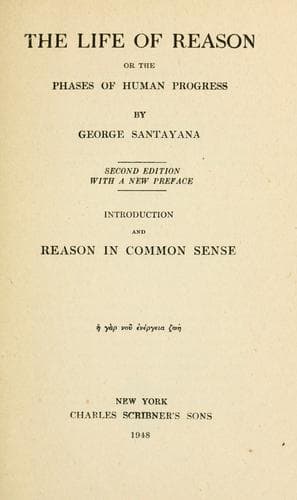
The Life of Reason: The Phases of Human ProgressSantayana, George
Philosophy
The Life of Reason: The Phases of Human Progress
Santayana, George
Philosophy
When the common ideal interests needed to give friendship a noble strain
become altogether predominant, so that comradeship and personal liking
may be dispensed with, friendship passes into more and more political
fellowships. Discipleship is a union of this kind. Without claiming any
share in the master’s private life, perhaps without having ever seen
him, we may enjoy communion with his mind and feel his support and
guidance in following the ideal which links us together. Hero-worship is
an imaginative passion in which latent ideals assume picturesque shapes
and take actual persons for their symbols. Such companionship, perhaps
wholly imaginary, is a very clear and simple example of ideal society.
The unconscious hero, to be sure, happens to exist, but his existence is
irrelevant to his function, provided only he be present to the
idealising mind. There is or need be no comradeship, no actual force or
influence transmitted from him. Certain capacities and tendencies in the
worshipper are brought to a focus by the hero’s image, who is thereby
first discovered and deputed to be a hero. He is an unmoved mover, like
Aristotle’s God and like every ideal to which thought or action is
directed.
The symbol, however, is ambiguous in hero-worship, being in one sense
ideal, the representation of an inner demand, and in another sense a
sensible experience, the representative of an external reality.
Accordingly the symbol, when highly prized and long contemplated, may
easily become an idol; that in it which is not ideal nor representative
of the worshipper’s demand may be imported confusedly into the total
adored, and may thus receive a senseless worship. The devotion which
was, in its origin, an ideal tendency grown conscious and expressed in
fancy may thus become a mechanical force vitiating that ideal. For this
reason it is very important that the first objects to fix the soul’s
admiration should be really admirable, for otherwise their accidental
blemishes will corrupt the mind to which they appear _sub specie boni_.
[Sidenote: Conflict between ideal and natural allegiance.]
Discipleship and hero-worship are not stable relations. Since the
meaning they embody is ideal and radiates from within outward, and since
the image to which that meaning is attributed is controlled by a real
external object, meaning and image, as time goes on, will necessarily
fall apart. The idol will be discredited. An ideal, ideally conceived
and known to be an ideal, a spirit worshipped in spirit and in truth,
will take the place of the pleasing phenomenon; and in regard to every
actual being, however noble, discipleship will yield to emulation, and
worship to an admiration more or less selective and critical.
[Sidenote: Automatic idealisation of heroes.]
Public-domain text, read in full here on John Shaqi.
Reviews
Reviews
No reviews yet
Be the first to share your thoughts on this work.
Elsewhere in the archive
Join the Discussion
Join the discussion
Sign in to leave a comment or review.
Sign InorCreate an account