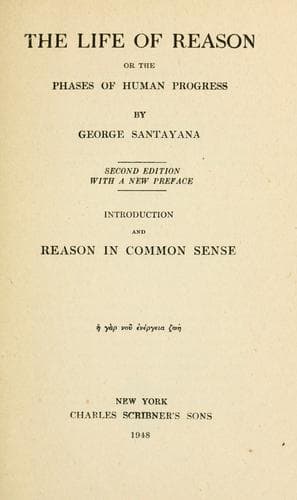
The Life of Reason: The Phases of Human ProgressSantayana, George
Philosophy
The Life of Reason: The Phases of Human Progress
Santayana, George
Philosophy
On the other hand, the free spirit, the political and speculative
genius in man, chafes under those blind involutions and material bonds.
Natural, beneficent, sacred, as in a sense they may be, they somehow
oppress the intellect and, like a brooding mother, half stifle what they
feed. Something drives the youth afield, into solitude, into alien
friendships; only in the face of nature and an indifferent world can he
become himself. Such a flight from home and all its pieties grows more
urgent when there is some real conflict of temper or conscience between
the young man and what is established in his family; and this happens
often because, after all, the most beneficent conventions are but
mechanisms which must ignore the nicer sensibilities and divergences of
living souls.
[Sidenote: Appeal from man to God, from real to ideal society.]
Common men accept these spiritual tyrannies, weak men repine at them,
and great men break them down. But to defy the world is a serious
business, and requires the greatest courage, even if the defiance touch
in the first place only the world’s ideals. Most men’s conscience,
habits, and opinions are borrowed from convention and gather continual
comforting assurances from the same social consensus that originally
suggested them. To reverse this process, to consult one’s own experience
and elicit one’s own judgment, challenging those in vogue, seems too
often audacious and futile; but there are impetuous minds born to
disregard the chances against them, even to the extent of denying that
they are taking chances at all. For in the first instance it never
occurs to the inventor that he is the source of his new insight; he
thinks he has merely opened his eyes and seen what, by an inconceivable
folly, the whole world had grown blind to. Wise men in antiquity, he
imagines, saw the facts as he sees them, as the gods see them now, and
as all sane men shall see them henceforward.
Thus, if the innovator be a religious soul, grown conscious of some new
spiritual principle, he will try to find support for his inspiration in
some lost book of the law or in some early divine revelation corrupted,
as he will assert, by wicked men, or even in some direct voice from
heaven; no delusion will be too obvious, no re-interpretation too
forced, if it can help him to find external support somewhere for his
spontaneous conviction. To denounce one authority he needs to invoke
another, and if no other be found, he will invent or, as they say, he
will postulate one. His courage in facing the actual world is thus
supported by his ability to expand the world in imagination. In
separating himself from his fellow-men he has made a new companion out
of his ideal. An impetuous spirit when betrayed by the world will cry,
“I know that my redeemer liveth”; and the antiphonal response will come
more wistfully after reflection:
“It fortifies my soul to know
That though I wander, Truth is so.”
Public-domain text, read in full here on John Shaqi.
Reviews
Reviews
No reviews yet
Be the first to share your thoughts on this work.
Elsewhere in the archive
Join the Discussion
Join the discussion
Sign in to leave a comment or review.
Sign InorCreate an account