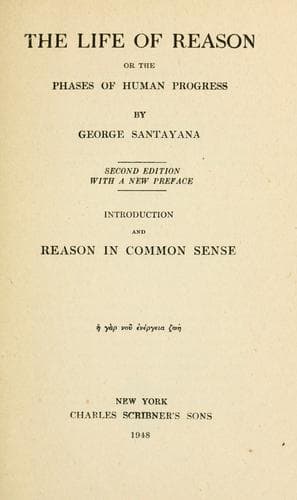
The Life of Reason: The Phases of Human ProgressSantayana, George
Philosophy
The Life of Reason: The Phases of Human Progress
Santayana, George
Philosophy
[Sidenote: Significant symbols revert to the concrete.]
The deceptions which nature practises on men are not always cruel. These
are also kindly deceptions which prompt him to pursue or expect his own
good when, though not destined to come in the form he looks for, this
good is really destined to come in some shape or other. Such, for
instance, are the illusions of romantic love, which may really terminate
in a family life practically better than the absolute and chimerical
unions which that love had dreamed of. Such, again, are those illusions
of conscience which attach unspeakable vague penalties and repugnances
to acts which commonly have bad results, though these are impossible to
forecast with precision. When disillusion comes, while it may bring a
momentary shock, it ends by producing a settled satisfaction unknown
before, a satisfaction which the coveted prize, could it have been
attained, would hardly have secured. When on the day of judgment, or
earlier, a man perceives that what he thought he was doing for the
Lord’s sake he was really doing for the benefit of the least, perhaps,
of the Lord’s creatures, his satisfaction, after a moment’s surprise,
will certainly be very genuine.
[Sidenote: Nature a symbol for destiny.]
Such kindly illusions are involved in the symbolic method by which
general relations and the inconceivably diffuse reality of things have
to be apprehended. The stars are in human thought a symbol for the
silent forces of destiny, really embodied in forms beyond our
apprehension; for who shall say what actual being may or may not
correspond to that potentiality of life or sensation which is all that
the external world can be to our science? When astrology invented the
horoscope it made an absurdly premature translation of celestial
hieroglyphics into that language of universal destiny which in the end
they may be made to speak. The perfect astronomer, when he understood at
last exactly what pragmatic value the universe has, and what fortunes
the stars actually forebode, would be pleasantly surprised to discover
that he was nothing but an astrologer grown competent and honest.
[Sidenote: Representative notions have also inherent values.]
Public-domain text, read in full here on John Shaqi.
Reviews
Reviews
No reviews yet
Be the first to share your thoughts on this work.
Elsewhere in the archive
Join the Discussion
Join the discussion
Sign in to leave a comment or review.
Sign InorCreate an account