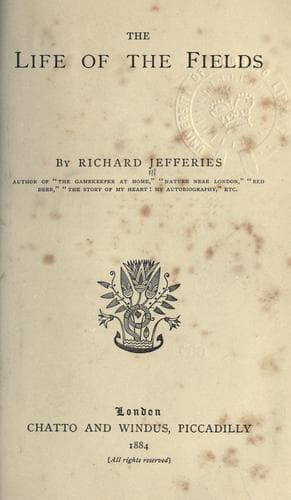
Natural history -- Outdoor books; Nature; Nature study; Paris (France) -- Description and travel
In the second year, Mr. Andrew came down, and one day met her in the
village. He did not know her. The stoop, the dress which clothed, but
responded to no curve, the sunken breast, and the sightless eye, how
should he recognise these? This ragged, plain, this ugly, repellent
creature--he did not know her. She spoke; Mr. Andrew hastily fumbled in
his pocket, fetched out half-a-crown, gave it, and passed on quickly.
How fortunate that he had not entangled himself!
Meantime, Mat drank and worked harder than ever, and became more
morose, so that no one dared cross him, yet as a worker he was trusted
by the farmer. Whatever it was, the fire in him burned deeper, and to
the very quick. The poppies came and went once more, the harvest moon
rose yellow and ruddy, all the joy of the year proceeded, but Dolly was
like a violet over which a waggon-wheel had rolled. The thorn had gone
deep into her bosom.
II
RURAL DYNAMITE
In the cold North men eat bread of fir-bark; in our own fields the
mouse, if pressed for food in winter, will gnaw the bark of sapling
trees. Frost sharpens the teeth like a file, and hunger is keener than
frost. If any one used to more fertile scenes had walked across the
barren meads Mr. Roberts rented as the summer declined, he would have
said that a living could only be gained from them as the mouse gains it
in frost-time. By sharp-set nibbling and paring; by the keenest
frost-bitten meanness of living; by scraping a little bit here, and
saving another trifle yonder, a farmer might possibly get through the
year. At the end of each year he would be rather worse off than before,
descending a step annually. He must nibble like a frost-driven mouse to
merely exist. So poor was the soil, that the clay came to the surface,
and in wet weather a slip of the foot exposed it--the heel cut through
the veneer of turf into the cold, dead, moist clay. Nothing grew but
rushes. Every time a horse moved over the marshy land his hoof left
deep holes which never again filled up, but remained the year through,
now puddles, full of rain water, and now dry holes. The rain made the
ground a swamp; the sun cracked it as it does paint. Who could pay rent
for such a place?--for rushes, flags, and water.
Public-domain text, read in full here on John Shaqi.
Reviews
Reviews
No reviews yet
Be the first to share your thoughts on this work.
Join the Discussion
Join the discussion
Sign in to leave a comment or review.
Sign InorCreate an account