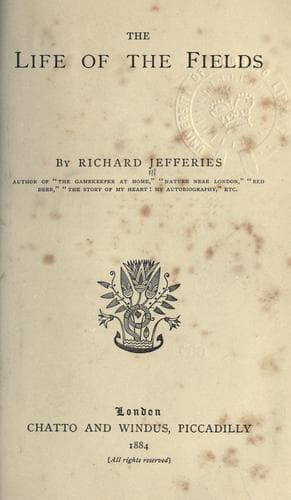
Natural history -- Outdoor books; Nature; Nature study; Paris (France) -- Description and travel
Yet it was said, with whisper and nod, that the tenant, Mr. Roberts,
was a warm man as warm men go after several years of bad seasons,
falling prices, and troubles of all kinds. For one thing, he hopped,
and it is noted among country folk, that, if a man hops, he generally
accumulates money. Mr. Roberts hopped, or rather dragged his legs from
rheumatics contracted in thirty years' hardest of hard labour on that
thankless farm. Never did any man labour so continually as he, from the
earliest winter dawn when the blackbird, with puffed feathers, still
tried to slumber in the thornbush, but could not for cold, on till the
latest summer eve, after the white barn owl had passed round the fir
copse. Both with his hands, and with his eyes, now working, now
watching, the man ceased not, and such was his dogged pertinacity that,
like the mouse, he won a living. He did more, he saved. At what price?
At the price of a fireless life: I mean without cheer, by denial of
everything which renders human life superior to that of the rabbit in
his burrow. No wife, no children, no niece, or any woman to see to his
comforts; no comfort and no pleasure; a bare house and rheumatism.
Bill, his principal labourer, Dolly's brother, slept with him in the
same bed, master and man, a custom common in old times, long since
generally disused.
Yet Mr. Roberts was not without some humanism, if such a word may be
used; certainly he never gave away a penny, but as certainly he cheated
no man. He was upright in conduct, and not unpleasant in manner. He
could not have been utterly crabbed for this one labourer, Bill, to
stay with him five-and-twenty years. This was the six-and-twentieth
year they had dwelt there together in the gaunt, grey, lonely house,
with woods around them, isolated from the world, and without a hearth.
A hearth is no hearth unless a woman sit by it. This six-and-twentieth
year, the season then just ended, had been the worst of the series;
rain had spoiled the hay, increased the payment of wages by lengthening
the time of hay-making; ruin, he declared, stared him in the face; he
supposed at last he must leave the tenancy. And now the harvest was
done, the ricks thatched with flags from the marsh (to save straw), the
partridges were dispersed, the sportsmen having broken up the coveys,
the black swifts had departed--they built every year in the grey stone
slates on the lonely house--and nothing was left to be done but to tend
the cattle morning and evening, to reflect on the losses, and to talk
ceaselessly of the new terror which hung over the whole district.
Public-domain text, read in full here on John Shaqi.
Reviews
Reviews
No reviews yet
Be the first to share your thoughts on this work.
Join the Discussion
Join the discussion
Sign in to leave a comment or review.
Sign InorCreate an account