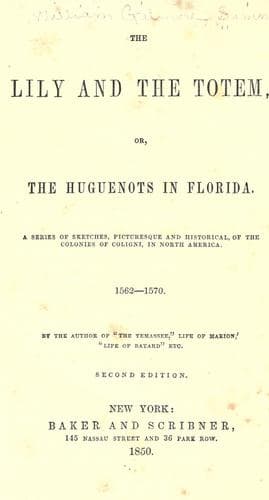
The Lily and the Totem; or, The Huguenots in Florida — John Shaqi
The Lily and the Totem; or, The Huguenots in FloridaSimms, William Gilmore
History
The Lily and the Totem; or, The Huguenots in Florida
Simms, William Gilmore
Florida -- History -- Huguenot colony, 1562-1565 -- Fiction
It is not so generally known that the colonies of the Huguenots, in
the new world, were almost coeval with those of the Spaniards. They
anticipated them in the northern portions of the continent. These
settlements were projected by the active genius of the justly-celebrated
French admiral, Gaspard de Coligny, one of the great leaders of the
Huguenots in France. His persevering energies, impelled by his sagacious
forethought, effected a beginning in the work of foreign colonization,
which, unhappily for himself and party, he was not permitted to
prosecute, with the proper vigor, to successful completion. His sagacity
led him to apprehend, from an early experience of the character of the
Queen-mother, in the bigoted and brutal reign of Charles the Ninth, that
there would, in little time, be no safety in France for the dissenters
from the established religion. The feebleness of the youthful
Prince, the jealous and malignant character of Catharine--her utter
faithlessness, and the hatred which she felt for the Protestants, which
no pact could bind, and no concession mollify,--to say nothing of the
controlling will of Pius the Fifth, who had ascended the Papal throne,
sworn to the extermination of all heresies,--all combined to assure the
Protestants of the dangers by which their cause was threatened. The
danger was one of life as well as religion. It was in the destruction of
the one, that the enemies of the Huguenots contemplated the overthrow
of the other. Coligny was not the man to be deceived by the hollow
compromises, the delusive promises, the false truces, which were all
employed in turn to beguile him and his associates into confidence,
and persuade them into the most treacherous snares. He combined a fair
proportion of the cunning of the serpent with the dove's purity, and,
maintaining strict watch upon his enemies, succeeded, for a long period,
in eluding the artifices by which he was overcome at last. Availing
himself of the influence of his position, and of a brief respite from
that open war which preceded the famous Edict of January, 1562, by which
the Huguenots were admitted, with some restrictions, to the exercise of
their religion, Coligny addressed himself to the task of establishing
a colony of Protestants in America. He readily divined the future
importance, to his sect, of such a place of refuge. The moment was
favorable to his objects. The policy of the Queen-mother was not yet
sufficiently matured, to render it proper that she should oppose herself
to his desires. Perhaps, she also conceived the plan a good one, which
should relieve the country of a race whom she equally loathed and
dreaded.[1] It is possible that she did not fully conjecture the
ultimate calculations of the admiral. The king, himself, was a minor,
entirely in her hands, who could add nothing to her counsels, or, for
the present, interfere with her authority; and, without seeking farther
to inquire by what motives she was governed in according to Coligny the
Public-domain text, read in full here on John Shaqi.
Reviews
Reviews
No reviews yet
Be the first to share your thoughts on this work.
Join the Discussion
Join the discussion
Sign in to leave a comment or review.
Sign InorCreate an account