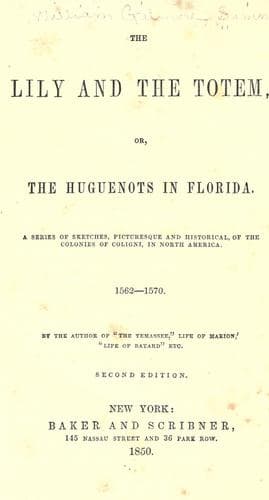
The Lily and the Totem; or, The Huguenots in FloridaSimms, William Gilmore
History
The Lily and the Totem; or, The Huguenots in Florida
Simms, William Gilmore
Florida -- History -- Huguenot colony, 1562-1565 -- Fiction
permission which he sought, it is enough that he obtained the necessary
sanction. Of this he readily availed himself. It was not, by the way,
his first attempt at colonization. Having in view the same objects by
which he was governed in the present instance, he had, in 1555, sent out
an expedition to Brazil under Villegagnon. This enterprise had failed
through the perfidy of that commander. Its failure did not discourage
the admiral. Though the full character of Catharine had not developed
itself, in all its cruel and heartless characteristics, it was yet
justly understood by him, and he never suffered himself to forget how
necessary to the sect which he represented was the desired haven of
security which he sought, in a region beyond her influence.
[1] Charlevoix expressly says, speaking, however, of Charles IX.,
"qu'il fut fort aise de voir que M. de Coligni n'employoit à cette
expédition que des Calvinistes, parce que c'étoit autant d'ennemis,
dont il purgeoit l'etat." Of Coligny's anxiety in regard to this
expedition and his objects, the same writer says: "Coligny had the
colony greatly at heart. It was, in fact, the first thing of which the
admiral spoke to the king when he obtained permission to repair to the
court."
From Brazil he turned his eyes on Florida. This _terra incognita_, at
the period of which we speak, was El Dorado to the European imagination.
It was the New Empire, richer than Peru or Mexico, in which adventurers
as daring as Cortes and Pizarro were to compass realms of as great
magnificence and wealth. Already had the Spaniard traversed it with his
iron-clad warriors, seeking vainly, and through numberless perils, for
the treasure which he worshipped. Still other treasures had won the
imagination of one of their noblest knights; and in exploring the wild
realm of the Floridian for the magical fountain which was to restore
youth to the heart of age, and a fresh bloom to its withered aspect,
Ponce de Leon pursued one of the loveliest phantoms that ever deluded
the fancy or the heart of man. To him had succeeded others; all seeking,
in turn, the realization of those unfruitful visions which, like
wandering lights of the swamp forest, only glitter to betray. Vasquez
d'Ayllon, John Verazzani, Pamphilo de Narvaez, and the more brilliant
cavalier than all, Hernando de Soto, had each penetrated this land of
hopes and fancies, to deplore in turn its disappointments and delusions.
With the wildest desires in their hearts, they had disdained the merely
possible within their reach. They had sought for possessions such as few
empires have been known to yield; and had failed to see, or had beheld
with scorn, the simple treasures of fruit and flower which the country
promised and proffered in abundance. This vast region, claimed equally
by Spain, France, and England, still lay derelict. "Death," as one of
our own writers very happily remarks, "seemed to guard the avenues of
Public-domain text, read in full here on John Shaqi.
Reviews
Reviews
No reviews yet
Be the first to share your thoughts on this work.
Join the Discussion
Join the discussion
Sign in to leave a comment or review.
Sign InorCreate an account