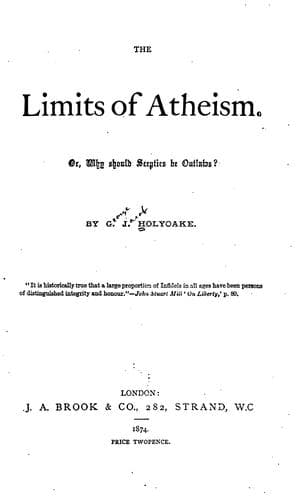
The Limits of Atheism; Or, Why Should Sceptics Be Outlaws?Holyoake, George Jacob
Religion
The Limits of Atheism; Or, Why Should Sceptics Be Outlaws?
Holyoake, George Jacob
Atheism
Produced by David Widger
THE LIMITS OF ATHEISM
Or, Why should Sceptics be Outlaws?
BY G. J. HOLYOAKE.
"It is historically true that a large proportion of Infidels
in all ages have been persons of distinguished integrity and
honour."--_John Stuart Mill 'On Liberty,_' p. 80.
LONDON: J. A. BROOK & CO., 282, STRAND, W.C
1874.
PRICE TWOPENCE.
REVEREND RICHARD WILLIAM JELF, D.D.,
PRINCIPAL OF KING'S COLLEGE, LONDON, WHO HAS LATELY ALARMED CONVOCATION
BY CONNECTING
THE 'ESSAYS AND REVIEWS' WITH ATHEISM
THESE PAGES,
WRITTEN IN ARREST OF THE PARLIAMENTARY JUDGMENT WHICH PLACES THE WORD OF
THE ATHEIST BELOW THAT OF THE FELON,
Are Respectfully Inscribed,
BY
GEORGE JACOB HOLYOAKE.
PREFACE.
The object of these pages* is not to defend the intellectual accuracy of
Atheism (which could not be attempted in this brief space), the object
is to explain its case, to vindicate its moral rectitude, and the right
of those who hold these views, to legal equality. There are two Atheisms
in literature--the ancient one of mere negation; and the affirmative
form, whose relevant name is Cosmism, and of which Humboldt, in
his 'Cosmos,' is a great illustrator, and Comte, in his 'Positive
Philosophy,' an expounder. The term Cosmism ought to supersede the
misleading term Atheism; just as Secularism has superseded the libellous
term Infidelity. Cosmism, as well as Secularism, expresses a new form
of Freethought, and I use the term Atheism, as the subject of a Lecture,
for the first time here. It is a worn-out word, used by Theists in
hateful senses. I employ it, as a title, to-day for political reasons,
in order to show those who make it a ground of civil exclusion, that
it is a thing of law and limits: that the reputed Atheism of English
working men, so far as it prevails, is no longer the old Atheism of
mere negation, but the Cosmism of modern science; neither dissolute,
anarchical, nor impious--recognises that the universe is, without
theorising _why_ it is. Negative Atheism says there is nothing beyond
the universe. Cosmism says it cannot explain anything beyond, and pauses
where its knowledge ends.
*A report of a Lecture delivered in Bendall's Assembly
Rooms, City Road, London, March 8rd, 1861.
Atheism questions--Cosmism affirms. The language of Cosmism is that of
the poet in the 'Purgatory of Suicides':--
'I do not say--there is no God,
But this I say--I know not.'
Public-domain text, read in full here on John Shaqi.
Reviews
Reviews
No reviews yet
Be the first to share your thoughts on this work.
Join the Discussion
Join the discussion
Sign in to leave a comment or review.
Sign InorCreate an account