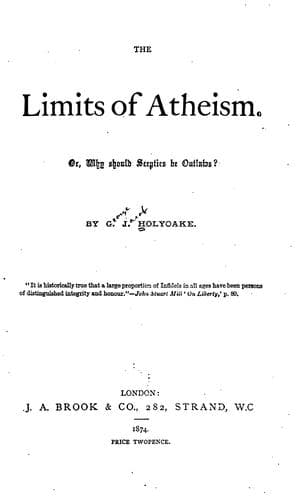
The Limits of Atheism; Or, Why Should Sceptics Be Outlaws?Holyoake, George Jacob
Religion
The Limits of Atheism; Or, Why Should Sceptics Be Outlaws?
Holyoake, George Jacob
Atheism
I prefer Secularism, which concerns itself with the moral life of
man, and maintains a well-advised neutrality upon these speculative
questions. My sympathies are with 'Adam Bede,' that striking and
greatest creation of modern genius, in which the _National Review_
recognised 'The strong-headed, manly, sharp-tempered, secular carpenter,
with his energetic satisfaction in his work, and impatience of
dreamers.' But as I stated in the York Debate, in 1858, at which the
Reverend Canons Hey and Robinson presided, it is an act of self-defence
in England to question the assumed infallibility of Theism--to prove
that Atheists are entitled to civil recognition, as persons having
legitimate, actual, and conscientious views, and who, therefore, ought
not to be outlawed as they are now. So long as sceptics of Theism are
refused the right of affirmation in courts of law, and their lives and
property consequently placed at the mercy of every ruffian and knave,
so long will a Sceptical propaganda be a parliamentary necessity, to
justify these opinions, and to spread them, that those who hold them
may, like the Quakers, win by pertinacity what is denied to reason. And
while this state of things lasts, I confess that I listen to arguments
of opponents with distrust, for I see in them, not so much the
confutation of my opinions, as the limitation of my freedom, and
the justification of my political exclusion. In the present state of
theological liberty in England, for the alleged Atheist to be silent, is
to be a slave consenting to his own degradation.
G. J. H.
147, Fleet Street, London, E.C., April 13th, 1861.
THE LIMITS OF ATHEISM
Twenty years ago I stepped forward to defend the right of expressing
Atheism on the part of those who conscientiously held it. On Mr.
Southwell's imprisonment in Bristol, I took his place as Editor of the
_Oracle of Reason_, and shared his fate at Gloucester. Under the same
circumstances I would do it again to-morrow. In the expression of
speculative opinions there may be error and there may be outrage;
but the error is best corrected by discussion, and the outrage by
cultivation; but to prohibit the free publication of opinion is to
strike at the root of all intrepidity of thought and individuality of
character; and against a uniformity of profession, whether brought about
by the tyranny of the majority, by the policeman, or by the magistrate,
I ever have, and ever will, protest as unwise, dishonest, and degrading.
Public-domain text, read in full here on John Shaqi.
Reviews
Reviews
No reviews yet
Be the first to share your thoughts on this work.
Join the Discussion
Join the discussion
Sign in to leave a comment or review.
Sign InorCreate an account