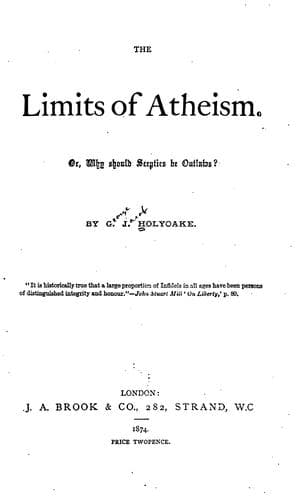
The Limits of Atheism; Or, Why Should Sceptics Be Outlaws? — John Shaqi
The Limits of Atheism; Or, Why Should Sceptics Be Outlaws?Holyoake, George Jacob
Religion
The Limits of Atheism; Or, Why Should Sceptics Be Outlaws?
Holyoake, George Jacob
Atheism
* As the late Gen. Jacob, the illustrious commander of the
Scinde Horse, testifies. 'In the jangle and desert, amid a
barbarous people on the extreme confines of civilisation,'
he applied these principles when Bishops despaired and
Christianity failed; and he records that 'He was permitted
to witness with delight the fact of a whole nation being
raised from a state of barbarous violence, misery,
detestable cruelty, and horror, to one of peace, comfort,
racial order, and happiness;' that 'He had seen their
faithful and steady application in practice change thousands
of the wildest robbers and murderers into kindly and
industrious citizens.
The wildness, excesses, extravagances, and incoherences of superstition,
arise through men looking without themselves into those regions of the
unknown where men make God after their own image, where they imagine
their facts, and reason upon them without check. How impertinent is
half our modern worship, and how poor the other half! Educated ministers
speak of God, and address to him praise they would be ashamed to
offer to any gentleman. That delicacy of reverence, that reticence of
laudation, that avoidance of presumption and familiarity, which the law
of humanity imposes on all men of religious habits in human relations,
has no existence in theology, where it is more to be expected and
infinitely more needful. When St. Augustine speaks of God, there is
a magnificent thoughtfulness in the terms he employs which his Pagan
refinement had taught him, which we seldom find in modern saints. How
imposingly he exclaims in his Confessions:--
What art Thou then, my God? Most highest, most good, most potent, most
omnipotent; most merciful, yet most just; most hidden, yet most
present; most beautiful, yet most strong; stable, yet incomprehensible;
unchangeable, yet all-changing; never new, never old; all-renewing, and
_bringing age upon the proud, and they know it not_; ever working, ever
at rest; still gathering, yet nothing lacking; supporting, filling, and
overspreading; creating, nourishing, and maturing; seeking, yet having
all things. Thou lovest, without passion; art jealous, without anxiety;
repentest, yet grievest not; art angry, yet serene; changest Thy works,
Thy purpose unchanged; receivest again what Thou findest, yet didst
never lose; never in need, yet rejoicing in gains; never covetous, yet
exacting usury. Thou receivest over and above, that Thou mayest owe;
and who hath aught that is not Thine? Thou payest debts, owing nothing;
remittest debts, losing nothing.'
We forgive the sublime contradictions in the stately march of this Pagan
praise. Augustine was a noble old saint, but he had a Pagan intellect to
the end.
Public-domain text, read in full here on John Shaqi.
Reviews
Reviews
No reviews yet
Be the first to share your thoughts on this work.
Join the Discussion
Join the discussion
Sign in to leave a comment or review.
Sign InorCreate an account