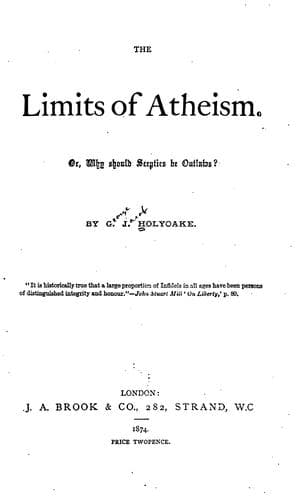
The Limits of Atheism; Or, Why Should Sceptics Be Outlaws? — John Shaqi
The Limits of Atheism; Or, Why Should Sceptics Be Outlaws?Holyoake, George Jacob
Religion
The Limits of Atheism; Or, Why Should Sceptics Be Outlaws?
Holyoake, George Jacob
Atheism
The 'Limits of Atheism' which obviously present themselves to those
who reflect upon them, rescue it from the imputation of lawlessness.
Positivism engrafts upon it practical aims. Exactness of speech
necessitates exactness of thought, and dictates modesty of pretension.
Dispassionateness of judgment checks invective, dogmatism, prejudice,
or unfairness; and Reliance upon Humanity tends to self-trust,
self-direction, and chastity of worship. Why should persons who hold
the views of Affirmative Atheism under these 'Limits' be treated in the
witness-box as public liars--men whose reiterated profession is--that
they 'sum up personal duty in Honour, which is respecting the Truth; in
Morality, which is acting the Truth; and in Love, which is serving the
Truth.'*
* 'Last Trial for Atheism,' p. 100.
Plato in his 'Laws,' remarks that 'Atheism is a disease of the soul
before it becomes an error of the understanding.' This just opinion, if
applied to mere sensualists, who disbelieve in God because his holiness
is a restraint upon their infamous passions, has since been applied to
the pure thinkers like Spinoza, to whom it is an insult and an
outrage. Let us see how little such a remark is applicable to those who
thoughtfully pause before adopting a creed which, however dictated by a
feeling of piety, is far less reverential than thoughtful silence.
If we suppose an interposing Providence to direct the affairs of this
world, what scenes of sorrow must meet his eye? Condemned to poverty and
pain, how many human beings are there whose every word is a prayer, and
every thought a throb, and every pulsation a pang? Is it not far more
reverential to struggle for the right with what powers we have, and
with what Secular light is vouchsafed, and own Theism inscrutable, than
connect all this misery with the name of God? The theory of a God of
Prayer who hears and aids, of a Providence who orders and controls, all
issues to one great Will, and who receives at last the sorrow-stricken,
the worn, struggling and weary spirit, after those conflicts which all
who think, and feel, and aspire, encounter, are primitive and enduring
conceptions, which all humanity, in every age and in every slime,
cherishes in its perplexity and clings to in its weakness. It is not
Cosmism which seeks or wishes to disprove this theory. Alas! the God of
Prayer does not exist. I say it not in wantonness, or recklessness, nor
in any proud spirit of defiance, nor in any hard spirit of denial, nor
in outrage, nor wilful scepticism, nor simulated disbelief. It appears
to me an austere fact, which all who observe must see, which all who are
frank must own. Yet I know not that I ought to say 'Alas it is so.' Why
should any man mourn at truth? What right have I to arraign the facts
of Nature. To mourn what _is_--is to condemn what is. Sorrow is censure
when it relates to what is possibly the order of God. What authority
have I to look on Nature awful in its glories and mysteries, and by the
Public-domain text, read in full here on John Shaqi.
Reviews
Reviews
No reviews yet
Be the first to share your thoughts on this work.
Join the Discussion
Join the discussion
Sign in to leave a comment or review.
Sign InorCreate an account