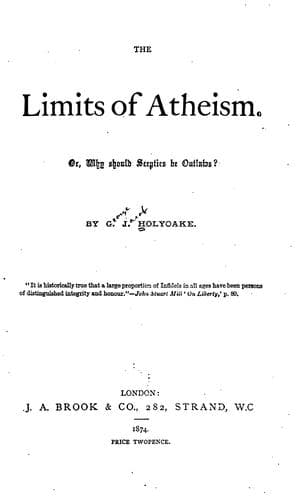
The Limits of Atheism; Or, Why Should Sceptics Be Outlaws?Holyoake, George Jacob
Religion
The Limits of Atheism; Or, Why Should Sceptics Be Outlaws?
Holyoake, George Jacob
Atheism
If we have said enough for this purpose, we may attempt to trace the
limits of our subject. The road through every high question lies over
precipices. Every great question has its Mont Blancs. The higher you
climb the deeper the chasms on the right hand and on the left. The Roman
Catholic makes worship an art, and abject submission a duty. To relieve
you of anxiety he deprives the mind of initiation and freedom. The
Protestant concedes you private judgment, and surrounds you by a social
despotism lest you should use it. He substitutes a creed for the Church.
The Church is a cell, and the creed is a cage. The cage is lighter, more
airy, and less repulsive than the cell, but the imprisonment is complete
in both.
Mere Atheism inculcates freedom and intrepidity of the understanding,
but may land you in negation, in dogmatism, in denunciation, in
irreverence. These are the chasms that lie in the path of mere Atheism.
The traveller who passes into these is lost. To avoid this danger we
must keep within the limits naturally prescribed to Affirmative Atheism,
which are:--
1. Positivism in Principle.
2. Exactness in Profession of Opinion.
3. Dispassionateness in Judgment.
4. Humanism in Conception.
1. The Positivist conception of Atheism exhibits the limits which modern
thought has impressed upon it. Affirmative Atheism asserts the
realism of Nature; Theism denies it. Theism refuses to recognise the
self-existence, the self-action, the self-subsistence, eternity, and
infinity of the universe. Theism is the negation of Nature. It is a
species of impiety towards nature, and supplants, by an artificial
superstition, the instinctive reverence of the human heart.
Modern Atheism is falsely regarded as a mere negation, as a species of
criminal vacuity of the understanding. To correct this idea is to win
for these opinions attention if not assent. The negation of any error is
useful, but it should be followed by its complement of positive truth.
All mere negative subjects are like the lime and pebbles swallowed by
farm fowl to assist digestion, but it fares ill with the fowl if they
get nothing but stones to digest; if no corn or barley follows to
be operated upon. Now, questions of Atheism and Scepticism are the
digestive stimuli of the mind; positive principles supply the corn and
barley which sustain the mental system and preserve its life. If we
give ourselves up to negative subjects merely, we come to resemble the
theologians who, as Talleyrand said, 'pick a great many bones for very
little meat.'
Public-domain text, read in full here on John Shaqi.
Reviews
Reviews
No reviews yet
Be the first to share your thoughts on this work.
Join the Discussion
Join the discussion
Sign in to leave a comment or review.
Sign InorCreate an account