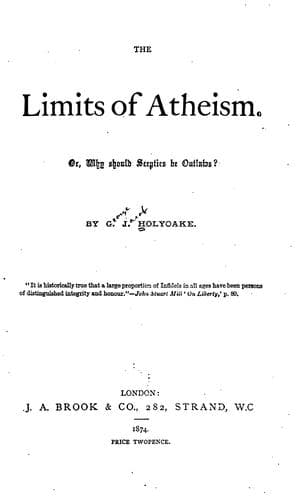
The Limits of Atheism; Or, Why Should Sceptics Be Outlaws?Holyoake, George Jacob
Religion
The Limits of Atheism; Or, Why Should Sceptics Be Outlaws?
Holyoake, George Jacob
Atheism
Affirmative Atheism may be wrong, but it is at least intelligible. It
has a definite foundation, or it could claim no position, and would
deserve none. It must go upon facts if it would maintain a place in the
kingdom of thought, and it finds these facts in Positivism. The mind
that has wandered in the torrid zones of error, thirsts ardently for the
cooling draughts of positive truth. It is this sentiment which causes
Freethought to take the form of Secularism, and exchanges the verbal
distractions of conflicting creeds for the clear criterions of moral
truth. It is the same wise impatience of metaphysical unrealities which
leads to Affirmative Atheism, and explains it. A series of material
and mental facts arrest the attention of one taking an unbiased and
independent view of the universe, of time, and space, and matter.
There are two classes of thinkers--one who commence with ignoring
Nature, seeking in something outside it for the origin of it, and who
look upon the infinite processes of the worlds which people space, with
the dull astonishment accorded to mere agencies, rather than with
the native wonder and awe which the consciousness of original powers
awakens--these are Theists.
The other class are those who regard matter as the very garment of the
unknown God, to whom every spray, and pebble, and flower, and star is a
marvel, a glory, and an inspiration; who, comprehending not an external
cause of nature, recognise its existence, its surpassing affluence, its
multitudinous marvels, and give them the first place in their wonder,
study, reverence, and love--these are Affirmative Atheists.
To believe in Nature, in its self-existence, its self-subsistence, its
self-action, its eternity, infinity, and materiality, and in that
only, is Affirmative Atheism.* Reflective Atheism is pure inability to,
realise the fact of the consciousness of the universe, or to conceive
the existence of a Being over it.
To believe in something besides nature--is Theism.
To believe in the consciousness of nature--is Pantheism.
The explanation of Affirmative Atheism* here given, involves many
considerations which I am not going to discuss. It is not my province
here to defend, but to state the case. A definition is a map, but it is
not the journey. A definition is a high road through a subject, and a
high road should be a straight road: it may run out of the way of some
populous towns and beautiful scenes, but it gives the means of quickest
transit through a territory, from which the country can be viewed, and
the traveller determine its general features.
* This might stand for a definition of Cosmism, which term I
employ at substantially reciprocal with Affirmative Atheism,
and as its substitute, if I may employ it in its modern and
wider sense than defined by Pythagoras.
Public-domain text, read in full here on John Shaqi.
Reviews
Reviews
No reviews yet
Be the first to share your thoughts on this work.
Join the Discussion
Join the discussion
Sign in to leave a comment or review.
Sign InorCreate an account