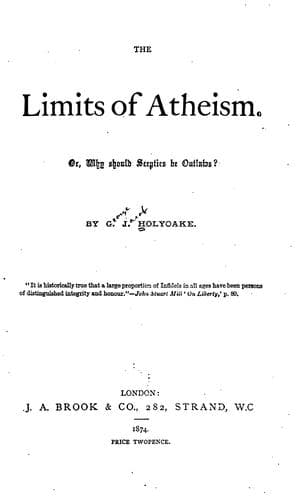
The Limits of Atheism; Or, Why Should Sceptics Be Outlaws?Holyoake, George Jacob
Religion
The Limits of Atheism; Or, Why Should Sceptics Be Outlaws?
Holyoake, George Jacob
Atheism
Man is forgiven who believes more than his neighbours, but he is never
forgiven if he believes less. If he believes more than his neighbours,
there is the presumption that he may have made some discovery which may
become profitable one day to join in. It may be that he who believes
most, may merely possess a more industrious credulity, or possess a
greater capacity for hasty assumption. But this is seldom probed. He
who believes less may have abandoned some important item of justifiable
belief. But when he who believes less than the multitude, confesses to
the fact in the face of public disapproval, the probability is that
he has inquired into, and sifted evidence which others have taken for
granted, and discovered some error which they have accepted. His greater
accuracy of mind and exactness of speech are an offence, because a
reproach to the careless or unscrupulous intellects of those who conduct
life on secondhand opinions. Yet austerity of intellect and austerity
of speech is as wholesome in character, as austerity of morals. I hope,
says Mr. Grote, in his great history of Greece, in a memorable passage
that ought not to die out of recollection, 'I hope, when I come to the
lives of Socrates and Plato, to illustrate one of the most valuable of
their principles, that conscious and confessed ignorance is a better
state of mind than the fancy without the reality of knowledge.' And in
a passage which I cannot now recall, Lord Brougham has said that 'a mind
uninformed is better than a mind misinformed.' In a state of ignorance
we do nothing, in a state of error we do wrong. The popular condemnation
of the Atheist--which we have lately heard as ignorantly echoed in the
House of Commons as in some Conventicles--is not always uttered, because
the Atheist does not know more than others, for none know anything
certain concerning the existence of God,* but because the Atheist does
not profess more.
* In his remarkable work entitled 'First Principles,' now in
course of publication, Mr. Herbert Spencer has shown that
certain terms of Cosmism are as incapable of ultimate
explanation as certain terms of Theism. This shows how
unwise is dogmatism, how unjustifiable is intolerance, on
either side.
Public-domain text, read in full here on John Shaqi.
Reviews
Reviews
No reviews yet
Be the first to share your thoughts on this work.
Join the Discussion
Join the discussion
Sign in to leave a comment or review.
Sign InorCreate an account