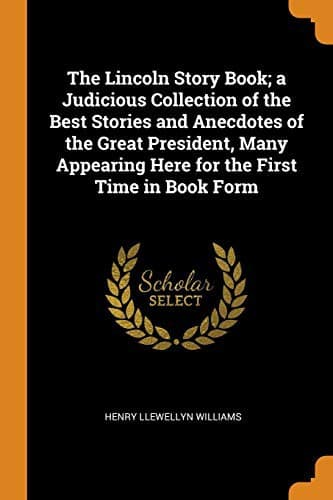
The Lincoln Story Book: A Judicious Collection of the Best Stories and Anecdotes of the Great President, Many Appearing Here for the First Time in Book Form
History
The Lincoln Story Book: A Judicious Collection of the Best Stories and Anecdotes of the Great President, Many Appearing Here for the First Time in Book Form
Lincoln, Abraham, 1809-1865 -- Anecdotes
In 1858, Lincoln was committed to the political campaign which was a
passing victory, superficial, to his opponent, Senator Douglas, to
eventuate in his accession to the Presidency. So he had let legal
strife fall into abeyance, during two years. He was, therefore, vexed
to have an applicant for his renewing that line of business, but at
once welcomed the suitor on learning her name. It was Hannah Armstrong.
He was eager to see her. She was the wife of the bully of Clary's
Grove, the locally noted wrestler, Jack Armstrong. After they had
become friends, Lincoln had been harbored in their cottage, in the days
when poverty held him down so he scarcely could get his head above
water. The good soul had repaid his doing chores about her house, such
as minding the baby, getting in the firewood, and keeping the highway
cows out of her cabbage-patch, after her husband died, by darning his
socks, filling up a bowl with corn-mush, at the period when it was a
feast to have "cheese, bologna, and crackers," in the garret where he
pored over law-books. Her news was painful. The baby, whose cradle
Lincoln had rocked, was a man now, and was in what the vernacular
phrased "pretty considerable of a tight fix."
It looked as though Mr. Lincoln would have difficulty in loosening the
fix, far more to remove it.
At a camp-meeting, the young men had been riotous. Armstrong and a
companion had been entangled in a fight for all comers, in which one
man was seriously injured by some weapon. The companion, Norris, was
tried and convicted for manslaughter of Metzgar, receiving the sentence
of eight years' imprisonment. But Armstrong was to be indicted for
murder, as the injuries were indicated as inflicted with a blunt
instrument, and a witness affirmed that they were done by a slung-shot
in Armstrong's hands. It was little excuse that he, like the rest
implicated, was drunk at the time. Nevertheless, dissolute as was the
young man of two-and-twenty, Lincoln did not need the woman's assurance
that her son was incapable of murder so deliberate. Armstrong averred
that any blow he struck was done with the naked fist. Furthermore, it
was said that Metzgar was not left insensible on the field of battle,
but was going home beside a yoke of oxen when the yoke-end cracked his
skull; it was this, and no slung-shot, that caused his death the
following day.
Recognizing that the complication forebode a strenuous task, Lincoln
none the less accepted it and, assuring his old "Aunt Hannah" that he
would not suffer her to talk of remuneration, he resumed the toga to
contest the effort to take away Armstrong's life and release Norris, as
convicted under error.
He closeted himself with the prisoner to hear his account, and upon
that concluded he was guiltless. It has been said that Lincoln would
never undertake a defense of a man he believed guilty. This held good
in the present instance.
Public-domain text, read in full here on John Shaqi.
Reviews
Reviews
No reviews yet
Be the first to share your thoughts on this work.
Join the Discussion
Join the discussion
Sign in to leave a comment or review.
Sign InorCreate an account