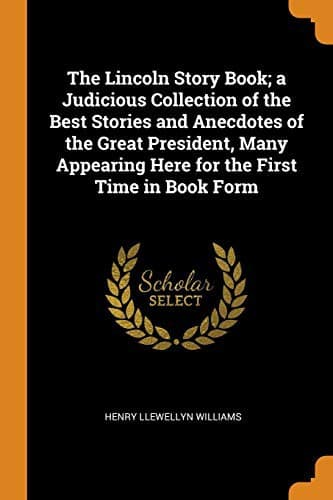
The Lincoln Story Book: A Judicious Collection of the Best Stories and Anecdotes of the Great President, Many Appearing Here for the First Time in Book Form
History
The Lincoln Story Book: A Judicious Collection of the Best Stories and Anecdotes of the Great President, Many Appearing Here for the First Time in Book Form
Lincoln, Abraham, 1809-1865 -- Anecdotes
Lincoln rose for the final, without eliciting any emotion from him. He
dilated on the evidence, which he asserted boldly was proof of a plot
against an innocent youth. He called the principal witness back to the
stand, and caused him definitely to repeat that he had _seen_ Armstrong
strike the fatal stroke, with a slung-shot undoubtedly, and by "the
light of the moon." The proof that his accusation was false was in the
advocate's hand--the almanac, which the usher handed into the jury,
while the judge consulted one on his desk.
The whole story was a fabrication to avenge a personal enmity, and the
rock of the prosecution was blasted by the defense's fiery eloquence.
The arbiters went out for half an hour, but the audience, waiting in
breathless impatience, discounted the result. The twelve filed in to
utter the alleviating "Not guilty!" and the liberator was able to
fulfil his pledge.
It was not sunset, and the prisoner was free to comfort his mother.
In vain did she talk of paying a fee, and the man supported the desire
by alleging his intention to work the debt out. Lincoln said in the old
familiar tongue:
"Aunt Hannah, I sha'n't charge you a _red_--I said 'without money or
price!' And anything I can do for you and yours shall not cost you a
cent."
Soon after, as she wrote to him of an attempt to deprive her of her
land, he bade her force a case into the court; if adverse there, appeal
to the Supreme Court, where his law firm would act, and he would fight
it out.
(Regarding the rescued man, he enlisted in the war at the first call.
He was still in the ranks two years later, when his mother, in her
loneliness, begged for him of the President-commander-in-chief, for his
release to come home. His leave was immediately written out by
Lincoln's own hand, and the soldier went home from Kentucky. He
remained a valuable citizen. It was Lincoln's speech and the moonbeam
of inspiration that saved him.)
* * * * *
"NICE CLOTHES MAY MAKE A HANDSOME MAN--EVEN OF YOU!"
In 1832, Lincoln, elected to the Illinois legislative chamber, found
himself in one of those anguishing embarrassments besetting him in all
the early stages of his unflagging ascent from the social slough of
despond. Unlike eels, he never got used to skinning. For the new
station, however well provided mentally, he had no means to procure
dress fit for the august halls of debate.
He was yet standing behind the counter in Offutt's general shop at New
Salem, when an utter stranger strolled in, asked his name, though his
exceptional stature and unrivaled mien revealed his identity, and
announced his own name. Each had heard of the other. The newcomer was
not an Adonis, perhaps, but he was one compared with the awkward,
leaning Tower of Pisa "cornstalk," who carried the jack-knife as "the
homeliest man in the section." Lincoln was doubly the _plainest_
speaker there and thereabouts.
Public-domain text, read in full here on John Shaqi.
Reviews
Reviews
No reviews yet
Be the first to share your thoughts on this work.
Join the Discussion
Join the discussion
Sign in to leave a comment or review.
Sign InorCreate an account