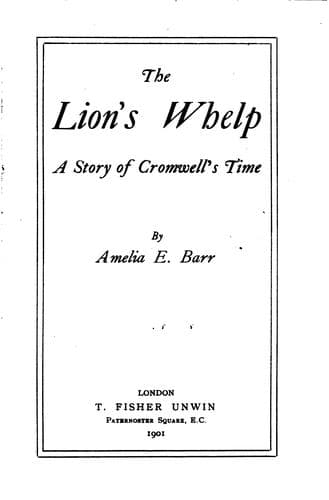
The Lion's Whelp: A Story of Cromwell's TimeBarr, Amelia E.
History
The Lion's Whelp: A Story of Cromwell's Time
Barr, Amelia E.
Great Britain -- History -- Stuarts, 1603-1714 -- Fiction
Mrs. Swaffham did not answer Jane’s remark. She was thinking of the
Quaker sermon at Oliver Leder’s, and wondering why they had not been
asked to hear it. "We ought to have been asked," she said to Jane as
they turned into the house. "Leaving out Swaffham was bad treatment,
and when I say bad, I mean bad. Did Matilda take the electuary for her
father?"
"She was very little in earnest, and had forgotten it but for my
reminding."
"She is much changed."
"It would be strange indeed if she was not changed. Before these
troubles she was a girl living at her mother’s knee, petted by her
father, and the idol of her brothers. Two of her brothers fell fighting
by the side of Prince Rupert, her mother wept herself into the grave for
them, her father is still nursing the wound he got at Naseby, and her
only brother, Stephen, is with Charles Stuart, wherever he may be. If
such troubles did not change a girl, she would be hewn from the very
rock of selfishness. Matilda is far from that. She loves with a whole
heart, and will go all lengths to prove it. We do not know the new
Matilda yet."
Jane would have made this remark still more positively, if she could
have seen her friend as soon as Swaffham was left behind. She sat
erect, lost in thought, and her eyes had a look in them full of anxiety
and sorrow. The sadness of an immense disillusion was over her. But
she belonged to that imperial race who never lose heart in any trouble.
To the very last she must hope; to the very last believe even against
hope and against reason. Her life had gone to ruin, but she trusted
that some miracle would restore it. Not for long could any mood of
despair subdue her; infallibly she must shake it away. For there was no
egotism in her grief, she could suffer cheerfully with others; it was
her isolation that hurt her. All her old friends had departed. The
grave had some; others had taken different ways, or battle and exile had
scattered them. By the side of her sick father she stood alone, feeling
that even Jane—her familiar friend—doubted her, no longer took her at
her word, called in question what she said, and held herself so far
aloof that she could not reach her heart. Oppressed by such
considerations, she felt like a child that suddenly realises it has lost
its way and is left alone in a wilderness.
Public-domain text, read in full here on John Shaqi.
Reviews
Reviews
No reviews yet
Be the first to share your thoughts on this work.
Join the Discussion
Join the discussion
Sign in to leave a comment or review.
Sign InorCreate an account