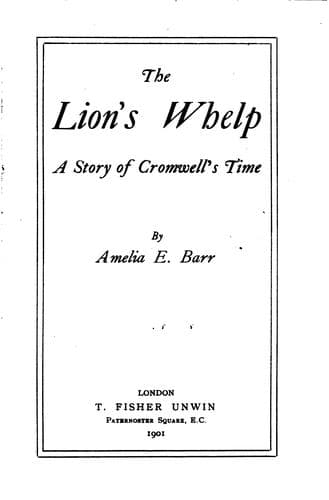
The Lion's Whelp: A Story of Cromwell's TimeBarr, Amelia E.
History
The Lion's Whelp: A Story of Cromwell's Time
Barr, Amelia E.
Great Britain -- History -- Stuarts, 1603-1714 -- Fiction
Nothing in her surroundings offered her any help. The road was flat and
dreary; a wide level intersected with deep drains and "droves"—a poor,
rough, moist land, whose horizon was only broken by the towers of Ely,
vast and gray in the distance. Large iron gates admitted her to de Wick
park, and she entered an avenue bordered with ash trees, veiled in mist,
and spreading out on either hand into a green chase full of tame deer.
The House—pieced on to the broad walls of an Augustine monastery—was
overshadowed by ash trees. It was a quadrangular building of various
dates, the gray walls rising from trim gardens with box-edged flower
plots and clipped yew hedges. There was a large fish pond teeming with
perch, and pike, and eels; and black colonies of rooks filled the
surrounding trees, and perched on the roof of the mansion. An old-world
sleepy air, lonely and apart and full of melancholy, pervaded the place.
But all these things were part and parcel of the word Home. Matilda
regarded them not in particular, they only affected her unconsciously as
the damp air or the gathering shadows of the evening did. The door
stood open, and she passed without delay into the wide entrance hall.
It was chill with the drifting fog, and dark with the coming night
shadows; but there was a good fire of ash logs at the upper end, and she
stood a few minutes before it, feeling a certain exhilaration in its
pleasant warmth and leaping flame. Then she went leisurely up the broad
stairway. It was of old oak with curiously carved balusters, surmounted
by grotesque animal forms; but she did not notice these ugly creations
as she climbed with graceful lassitude the dark steps, letting her silk
robe trail and rustle behind her. Her hat, with its moist drooping
feathers, was in her hand; her hair hung limply about her brow and face;
she was the very picture of a beauty that had suffered the touch of
adverse nature, and the depression of unsympathetic humanity.
But the moment she entered her own room she had the sense of covert and
refreshment. Its dark splendour of oak and damask was brought out by
the glow and flame of firelight and candle-light; and her maid came
forward with that air of affectionate service, which in Matilda’s
present mood seemed of all things most grateful and pleasant. She put
off her sense of alienation and unhappiness with her damp clothing, and
as the comfort of renewal came to her outwardly, the inner woman also
regained her authority; and the girl conscious of this potent
personality, erected herself in its strength and individuality. She
surveyed her freshly clad form in its gown of blue lutestring; she
turned right and left to admire a fresh arrangement of her hair; she put
around her neck, without pretense of secrecy or apology, the rosary of
coral and gold; and admired the tint and shimmer of its beauty on her
white throat. Then she asked—
"Was any stranger with the Earl at dinner, Delia?"
Public-domain text, read in full here on John Shaqi.
Reviews
Reviews
No reviews yet
Be the first to share your thoughts on this work.
Join the Discussion
Join the discussion
Sign in to leave a comment or review.
Sign InorCreate an account