The Lion's Whelp: A Story of Cromwell's Time — John Shaqi
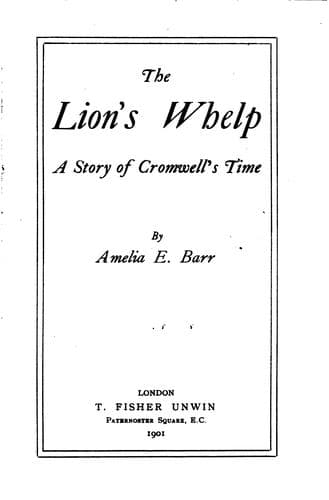
The Lion's Whelp: A Story of Cromwell's TimeBarr, Amelia E.
History
The Lion's Whelp: A Story of Cromwell's Time
Barr, Amelia E.
Great Britain -- History -- Stuarts, 1603-1714 -- Fiction
During the seventeenth century Swaffham Manor House was one of the most
picturesque dwellings in Cambridgeshire. It was so old that it had a
sort of personality. It was Swaffham. For as the Yorkshireman, in
speaking of his beloved rivers, disdains the article "the" and calls
them with proud familiarity, Aire, Ure, Ribble, so to the men of the
country between Huntingdon and Cambridge, this ancient dwelling was
never the Manor House; it was the synonym of its builders, and was
called by their name—Swaffham. For it was the history of the Swaffham
family in stone and timber, and no one could enter its large, low rooms
without feeling saturated and informed with the spiritual and physical
aura of the men and women who had for centuries lived and died under its
roof.
The central tower—built of the white stone of the neighbourhood—-was the
fortress which Tonbert Swaffham erected A.D. 870, to defend his lands
from an invasion of the Danes; and five generations of Tonbert’s
descendants dwelt in that tower, before William of Normandy took
possession of the crown of England. The Swaffham of that date became a
friend of the Conqueror; the Manor was enriched by his gifts; and the
Manor House—enlarged and beautified by various holders—had the singular
fortune to be identified with the stirring events of every dynasty.
In the middle of the seventeenth century it still retained this
character. Puritan councils of offense and defense had been held in its
great hall, and parliamentary soldiers drilled in its meadows. For
Captain Israel Swaffham was the friend of General Cromwell, and at the
time this story opens was with Cromwell in Scotland. Nothing of good in
the old race was lacking in Captain Israel. He was a soldier going
forth on a holy errand, hurrying to serve God on the battle-field;
faithful, as a man must be who could say after a hard day’s fighting,
"Tired! No. It is not for me to let my right hand grow tired, if God’s
work be half-done."
A great fighter, he had no parliamentary talent, and no respect for
parliaments. He believed England’s religious and civil liberties were
to be saved by the sword, and the sword in the hand of his great leader,
Oliver Cromwell; and when the King’s fast-and-loose proposals had been
discussed by the men of Cambridgeshire, in Swaffham, he had closed the
argument with this passionate declaration:
"There is no longer disputing with such a double mind as the mind of
Charles Stuart. The very oath of God would not bind him. Out,
instantly, all of you who can!"
His three sons rose at his words and the rest of the council followed,
for all felt that the work was but half done—there was to be a Second
Civil War. Then home was again deserted for the battle-field, and
Captain Swaffham’s wife and daughter were once more left alone in the
old Manor House.
Public-domain text, read in full here on John Shaqi.
Reviews
Reviews
No reviews yet
Be the first to share your thoughts on this work.
Join the Discussion
Join the discussion
Sign in to leave a comment or review.
Sign InorCreate an account