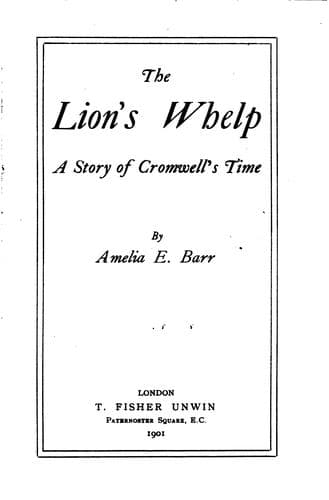
The Lion's Whelp: A Story of Cromwell's TimeBarr, Amelia E.
History
The Lion's Whelp: A Story of Cromwell's Time
Barr, Amelia E.
Great Britain -- History -- Stuarts, 1603-1714 -- Fiction
Mrs. Swaffham was the child of a Puritan minister, and she had strong
Puritan principles; but these were subject to passing invasions of
feeling not in accord with them. There were hours when she had pitied
the late King, excused his inexcusable treacheries, and regretted the
pomps and ceremonies of royal state. She had even a feeling that
England, unkinged, had lost prestige and was like a dethroned nation.
In such hours she fretted over her absent husband and sons, and said
words hard for her daughter Jane to listen to with any sympathy or
patience.
For Jane Swaffham was of a different spirit. She had a soul of the
highest mettle; and she had listened to those English mystics, who came
out of the steel ranks of triumphant Puritanism, until she had caught
their spirit and been filled through and through with their faith. The
Swaffhams were a tall race; but Jane was a woman of small stature and
slender frame, and her hair, though abundant, wanted the rich brown hue
that was the heritage of the Swaffham beauties. No one spoke of Jane as
a beauty; the memory of her sister Amity—who had married Lord
Armingford—and of her aunt, Cicely Compton, both women of rare
loveliness, qualified Jane’s claim to this family distinction. And yet
she had a fresh, bright face, a face like a sweet single rose of the
wood; one could see straight to her heart through it—a loving, cheerful
daughter of righteousness; not perfect by any means; subject to little
bursts of temper, and to opinions so positive they had the air of
bigotry; but with all her faults holding that excellent oneness of mind,
which has no doubts and no second thoughts.
This was the maiden who was sitting, one sunny afternoon, at the open
window of the household parlour in Swaffham. The lazy wind brought her
delicious puffs of sweetbrier scent, and in the rich fields beyond the
garden she could hear the voices of the reapers calling to each other as
they bound the wheat. On the hearthstone, her mother’s wheel hummed in
a fitful way, now rapidly, now slowly, anon stopping altogether. Jane
was quite idle. A tray full of ripe lavender spikes was at her side and
a partly finished little bag of sheer muslin was in her hand, but the
work was not progressing. When thoughts are happy, the needle flies,
when they are troubled or perplexed, the hands drop down and it becomes
an effort to draw the thread. Jane was thinking of her father and
brothers, of the unhappy condition of England, and of the unrest in
their own household. For she knew that her mother was worried about
many things, and the fret that was bred in the kitchen and the farm
offices—in spite of all her efforts—insinuated itself into the still
order of the handsome room in which she was sitting. She felt her
mother’s silence to be unpleasantly eloquent. The fitful wheel
complained. It was a relief when Mrs. Swaffham brought to audible
conclusions, the voiceless tension in which they were sitting.
Public-domain text, read in full here on John Shaqi.
Reviews
Reviews
No reviews yet
Be the first to share your thoughts on this work.
Join the Discussion
Join the discussion
Sign in to leave a comment or review.
Sign InorCreate an account