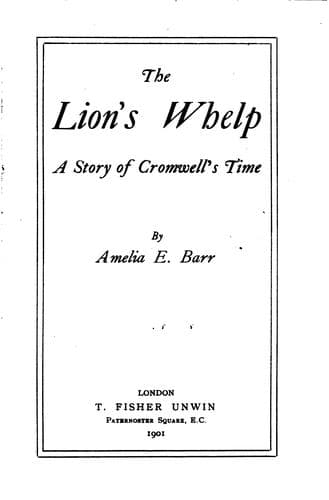
The Lion's Whelp: A Story of Cromwell's TimeBarr, Amelia E.
History
The Lion's Whelp: A Story of Cromwell's Time
Barr, Amelia E.
Great Britain -- History -- Stuarts, 1603-1714 -- Fiction
It will be well now to recall the positions which Charles Stuart and
Cromwell, with their armies, occupied. The royalist defeat at Dunbar
occurred on September the third, A.D. 1650, and Charles, after it,
sought shelter in the fortress of Stirling Castle, where he remained
until he went to Perth. Here, on January the first, 1651, he was
crowned King of Scotland, and then he assumed the command of
Captain-General of the Scotch forces, having under him the Duke of
Hamilton and David Leslie. At this time the Scotch army had become
purely royal and malignant, the Kirk having done its part had retired,
leaving the King to manage his own affairs. During the winter, which
was long and severe, Charles and his army could do nothing; but when
fine weather came and they understood that Cromwell would march to
Perth, the Scotch army went southward, fortifying itself on the famous
Torwood Hill, between Stirling and Falkirk.
This long winter had been one of great suffering to General Cromwell.
After making himself master of the whole country south of Forth and
Clyde, he had a severe illness, and lay often at the point of death. In
the month of May two physicians were sent by Parliament from London to
Edinburgh to attend him, but ere they arrived, the Lord Himself had been
his physician and said unto him, Live! He took the field in June,
throwing the main part of his army into Fife, in order to cut off the
enemy’s victual. This move forced the hand of Charles Stuart. His army
was in mutiny for want of provisions, the North country was already
drained, he durst not risk a battle—but the road into England was clear.
Cromwell himself had gone northward to Perth, and on the second of
August he took possession of that city; but while entering it was told
that Charles Stuart, with fourteen thousand men, had suddenly left
Stirling and was marching towards England. Cromwell was neither
surprised nor alarmed; perhaps, indeed, he had deliberately opened the
way for this move by going northward to Perth, and leaving the road to
England open. At any rate, when Charles reached the border he found
Harrison with a strong body of horse waiting for him, while Fleetwood
with his Yorkshiremen lay heavy on his left flank, and Lambert with all
the English cavalry was jogging on, pressing close the rear of his army.
For in Lambert’s ears was ringing night and day Cromwell’s charge to
him,—
"Use utmost diligence! With the rest of the horse and men I am
hastening up, and by the Lord’s help, I shall be in good time."
Public-domain text, read in full here on John Shaqi.
Reviews
Reviews
No reviews yet
Be the first to share your thoughts on this work.
Join the Discussion
Join the discussion
Sign in to leave a comment or review.
Sign InorCreate an account