The Lion's Whelp: A Story of Cromwell's Time — John Shaqi
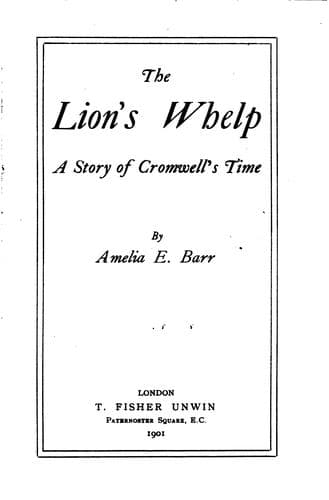
The Lion's Whelp: A Story of Cromwell's TimeBarr, Amelia E.
History
The Lion's Whelp: A Story of Cromwell's Time
Barr, Amelia E.
Great Britain -- History -- Stuarts, 1603-1714 -- Fiction
Charles had taken the western road by Carlisle, and it was thought he
would make for London. He went at a flying speed past York, Nottingham,
Coventry, until he reached the borders of Shropshire, summoning every
town he passed, but hardly waiting for the thundering negatives that
answered his challenge; for the swift, steady tramp of Cromwell’s
pursuit was daily drawing nearer and nearer. Reaching Shrewsbury, he
found the gates shut against him, and his men were so disheartened that
the King with cap in hand entreated them "yet a little longer to stick
to him." For all his hopes and promises had failed, there had been no
rising in his favour, no surrender of walled towns, and the roads
between Shrewsbury and London were bristling with gathering militia. So
Charles turned westward to Worcester, a city reported to be loyal, where
he was received with every show of honour and affection. Here he set up
his standard on the ill-omened twenty-second of August, the very day
nine years previous, on which his father had planted his unfortunate
standard at Nottingham.
Meanwhile Cromwell was following Charles with a steady swiftness that
had something fateful in it. He had taken Perth on the second of
August; he left it with ten thousand men on the third; he was on the
border by the eighth; he was at Warwick on the twenty-fourth, where he
was immediately joined by Harrison, Fleetwood and Lambert. Such
swiftness and precision must have been prearranged, either by Cromwell
or by Destiny. It was to be the last battle of the Civil War, and
Cromwell knew it, for he had beyond the lot of mortals that wondrous
insight, that prescience, which, like the scabbard of the sword
Excalibur, was more than the blade itself—the hilt armed with eyes.
There was in his soul, even at Perth, the assurance of Victory, and as
he passed through the towns and villages of England, men would not be
restrained. They threw down the sickle and the spade in the field, the
hammer in the forge, the plane at the bench, and catching hold of the
stirrups of the riders, ran with them to the halting-place. Cromwell had
no need to beg Englishmen yet a little longer to stick to him. His form
of rugged grandeur, the majesty and fierceness of his face, and his air
of invincible strength and purpose, said to all, _This is the Pathfinder
of your English Freedom! Follow Him!_ The man was a magnet, and drew
men to him; he looked at them, and they fell into his ranks; he rode
singing of Victory at their head, and women knelt on the streets and by
the roadside to pray for the success of those going up "_For the help of
the Lord, and for England._" This battle call, ringing from men at full
spur, was taken up even by the old crones and little children, and their
shrill trebles were added to the mighty shouting of strong men, whose
heroic hands were already tightly closed upon their sword-hilts. So,
with his ten thousand troops augmented to thirty thousand, he reached
Public-domain text, read in full here on John Shaqi.
Reviews
Reviews
No reviews yet
Be the first to share your thoughts on this work.
Join the Discussion
Join the discussion
Sign in to leave a comment or review.
Sign InorCreate an account