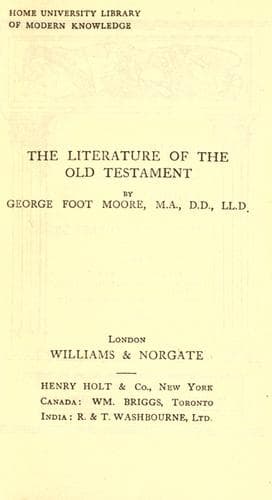
The Literature of the Old TestamentMoore, George Foot
Religion
The Literature of the Old Testament
Moore, George Foot
Bible. Old Testament -- Introductions
Naturally, therefore, Luther reverted to the position of Jerome: the
books found in the Hebrew Bible, and those only, were the Scriptures
of the Old Testament; whatever was more than these was to be reckoned
among the apocrypha. In the first complete printed edition of his
translation (1534), these books (Judith, Wisdom, Tobit, Sirach,
Baruch, 1 and 2 Maccabees, the Greek additions to Esther and Daniel,
the Prayer of Manasseh) stand between the Old Testament and the New,
with the title (after Jerome) "_Apocrypha_; that is, books that are
not equally esteemed with the Holy Scripture, but nevertheless are
profitable and good to read." The other Protestant versions, on the
Continent and in England, followed this example.
The attitude of Luther toward the Old Testament Apocrypha was
maintained by the Lutheran Churches, whose Confessions do not,
however, attempt a more exact definition of the value and authority of
the Apocrypha. The earlier Reformed (Calvinistic) Confessions take
substantially the same ground: the Ecclesiastical Books, or Apocrypha,
are useful, especially for moral instruction, but they have not the
same authority as the canonical books, and doctrines may not be
deduced from them alone. The Articles of the Church of England (1563;
English translation, 1571) agree on this point with the other Reformed
Confessions: after enumerating the canonical books "of whose authority
there was never any doubt in the Church," the Sixth Article continues:
"And the other books (as Hierome saith) the Church doth read for
example of life, and instruction of manners; but yet it doth not apply
them to establish any doctrine." A list of such books follows,
comprising those commonly printed in the English Bible under the title
Apocrypha.
A more radical position was represented by the Synod of Dort (1618)
and by the Westminster Assembly (1643). The latter declares: "The
books commonly called Apocrypha, not being of divine inspiration, are
no part of the canon of Scripture; and therefore are of no authority
in the church of God, nor to be otherwise approved, or made use of,
than other human writings."
Public-domain text, read in full here on John Shaqi.
Reviews
Reviews
No reviews yet
Be the first to share your thoughts on this work.
Join the Discussion
Join the discussion
Sign in to leave a comment or review.
Sign InorCreate an account