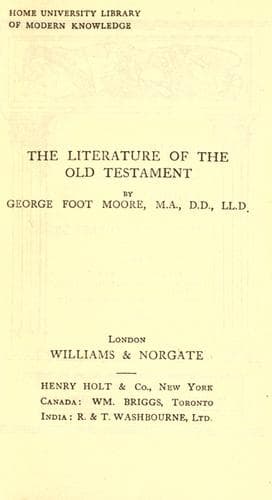
The Literature of the Old TestamentMoore, George Foot
Religion
The Literature of the Old Testament
Moore, George Foot
Bible. Old Testament -- Introductions
In the treatment of the common tradition in J and E, respectively,
local or national interests appear, from which it is generally
inferred that E was written in the Northern Kingdom (Israel) and J in
the Southern (Judah). The question of the age of these writings can be
more profitably considered at a later stage of our inquiry.
The patriarchal history which begins with the migration of Abraham,
Gen. 12, is preceded by what may be called the primeval history of
mankind, Gen. 1-11. In these chapters E is not represented, and it
seems probable that the Israelite historian began his book with
Abraham. The primeval history as we read it, therefore, is derived in
part from J, in part from P. From J come Gen. ii. 4b-iv. 25; vi. 1-8;
a part of the composite story of the Flood (vii. 1-5, 7-10, 12, 17b,
22-23; viii. 6-12, 13b, 20-22); the sons of Noah, ix. 18-27, and part
of the table of nations (x. 8-19, 21, 24-30); the Tower of Babel (xi.
1-9). These pieces do not form a literary unity, and they give
evidence, as we should expect, of diverse origin. There are some among
them which imply a continuous development of civilization, unbroken by
the catastrophe of the Deluge, and Noah himself was originally an
agricultural figure, the first vine-dresser and maker of wine, not the
navigator of the ark. The tradition which ascribes the invention of
the arts of primitive civilization to descendants of Cain (Gen. iv.
17-24) is obviously of different origin from the story of Cain and
Abel. Closer inspection shows that the narrative of J in Gen. 1-11 is
composed of two strands, each having a consistency and continuity of
its own, and similar phenomena appear in subsequent parts of the
history from Genesis to Samuel.
If these various elements are alike designated by the symbol J, it is
because they exhibit the peculiarities of conception and expression
which characterize that work. The God who walks for pleasure in his
garden in the cool of the day, misses his gardeners, and finding that
they have eaten the forbidden fruit of the tree of knowledge, drives
them out of the garden for fear they might also put out their hands to
the tree whose fruit gives immortality, or who comes down to see the
tower the Babylonian heaven-stormers are building, and apprehending
more presumptuous attempts from their success, breaks up their concert
by the ingenious device of making them talk different languages, is
plainly imagined in quite the same way as the God who visits Abraham
on his way to Sodom or wrestles with Jacob or tries to kill Moses on
the road to Egypt. Even more primitive is the fragment, Gen. vi. 1-4,
telling how deities, captivated by the charms of mortal women, begot
with them a mythical race of giants.
Public-domain text, read in full here on John Shaqi.
Reviews
Reviews
No reviews yet
Be the first to share your thoughts on this work.
Join the Discussion
Join the discussion
Sign in to leave a comment or review.
Sign InorCreate an account